Chronicles of the Shade – Episode 10 – “The Circle is Completed”
Chronicles of the Shade©*
By Margot Cranston and Sam Miller
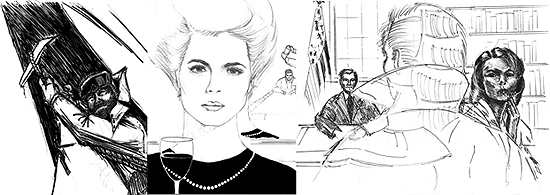
Episode 10 –
The Circle is Completed
September 2007
Wilby Goode dialed the number of The Shade Detective Agency. Lucienne Dufrenne answered the telephone with her characteristic vivacity and her charming French accent. No, she said, M’sieur Cart-tay had not arrived yet, but she expected him soon. Wilby gave her his cell phone number and asked her to ring him when Lance Carter arrived at the office. Twenty minutes later, it was Lance himself who returned his call.
“I’ve got some news for you,” said Wilby. “It’s about the tapes. I’d like to be able to tell you what happened in person, and I’d also like to give you the fee that we agreed on for your work. May I come to your office some time today?”
Lance looked at his daily calendar. “I’m afraid I’m going to be tied up all day,” he said. What about coming to my townhouse this evening? If you’ve got pen and paper handy, I’ll give you directions.”
That evening found Wilby sitting in Lance’s living room, a glass of Glen Levitt warming in his hands. Wilby was not a Scotch drinker, but Lance had insisted; and Wilby found that he enjoyed the smooth taste of the single-malt Scotch whiskey. He recounted for Lance the details of his conversation with Fancy Bugliosi and told him of the deal that had been struck. Lance listened attentively, and then he put his own glass down on the table in front of him and leaned towards Wilby.
“So you agreed not to publish the tapes. I have to tell you, Wilby, that was quite a selfless act. You could have made a pretty penny with them, not to mention the fame that would have come your way with your exclusive story based on them.”
Wilby shrugged. “It doesn’t matter,” he said. “My father taught me that there’s such a thing as the greater good.” Besides, I can always write my story after Liar leaves office. It was worth it to me to get Chancey and Spice out of the picture and not able to cause more harm to the country. By the way, I’ve written you a check to cover the fee we agreed on for your investigative work. It was worth every penny.”
“Put your money away, Wilby,” said Lance, holding up both his hands. “You’ve already paid my expenses, and I refuse to take anything more. If you ever publish those tapes, you can pay me then.”
Seeing that Lance meant what he said, Wilby folded the check and put it in his shirt pocket. “I would like to know how you got the material on those tapes,” he said, “but I guess that would be giving away trade secrets, wouldn’t it?”
Lance smiled. “Maybe some day I’ll tell you, Wilby. What I’d like to know from you, though, is what lies behind this keen sense of justice that motivates you. Surely, it can’t be merely what your father told you about a greater good, can it?” Lance was pressing. He wanted to know more about Wilby, and Wilby seemed not to want to tell him any more than he was asked.
Wilby took a careful sip of his Glen Levitt. He then looked squarely at Lance and began the story about his great-grandfather, G. I. Goode, and the chance meeting he had with his brother Billy close by the battlefields of France in the Great War. He told Lance about the pact the brothers had made, about initialing a scrap of paper to ensure that they would meet again to celebrate the war’s end. He told Lance about Billy’s being killed and about George’s leaving France forever. He told him that the story had been passed down to his grandfather, then to his father, and finally to him. It was a bond that tracked the generations, one that translated into a family creed of honor, loyalty, and service.
“What happened to that scrap of paper?” Lance asked, curious to learn more about the man who had seemed so desperate scarcely two months ago in asking The Shade for help, a man who now seemed poised, calm, and thoughtful.
“My great-grandfather asked a young Frenchwoman to keep it safe for him and Billy,” he said. “When she protested that she might lose it, he gave her something to put it in. It was a locket that he had bought in Paris, thinking to give it to his mother when he returned home. As I said, the two brothers were fairly inebriated, and I believe that George slept the night in that wine cellar after Billy had left to return to the front lines.”
Lance felt a frisson of recognition course through his body. Very deliberately, he reached into his shirt pocket and retrieved Aunt Viva’s golden locket. As Wilby stared at him, his jaw dropping, Lance opened the locket and drew forth the little paper within. He unfolded the paper and handed it over to Wilby. “Was it something like this that your great-grandfather gave to that young Frenchwoman?” he asked.
With trembling hands, Wilby held the paper before his eyes and read the words on it: “Preserve the Union.” He looked below the words and saw the initials G. I. G. and W. R. G. He then looked back at Lance, his eyes shining. “I can’t believe it,” he murmured. “These are the initials of my great-grandfather and his brother Billy—George I. Goode and William R. Goode. Where in the world did you come upon this locket?”
“This was my Aunt Viva’s locket, Wilby. “Actually, she was my grandmother. She was bequeathed the locket by her mother, who said it was given to her for safekeeping by a young and dashing American army lieutenant. I think your great-grandfather did more than sleep in that wine cellar on that night, Wilby. I do believe that we are related.”
Wilby rose from his chair in utter amazement. “Then the circle is completed,” he said in a tremulous voice. “Even though George and Billy were never able to celebrate, here we are, 90 years later, meeting and celebrating in their place.” With that, Wilby raised his glass and said, “Preserve the Union.”
Lance rose, as well, and raised his glass in a toast. “Preserve the Union,” he said. “But I’m still puzzled as to why our ancestors would use Lincoln’s phrase to mark their proposed reunion.”
Wilby laughed. “No, it wasn’t Lincoln’s phrase they had in mind. It simply signified preserving the union of two brothers. That’s the only meaning they gave the words in the locket. They wanted to let each other know that, no matter what, they would always stay loyal to one another.”
Then the scales fell from Lance’s eyes. It was as if cataract surgery had cleared his vision. All this time he had misconstrued what the words on the paper meant. He had agonized about how he could both preserve the union and renounce the world. He now saw how simple it was. Two brothers, one about to die, had made a pact always to be faithful to one another. Finally, he extended the locket to Wilby and said, “By rights this locket and its contents belong to you. It was your great-grandfather who bought the locket for his mother, and it was he who wrote the words on the paper inside it. My great-grandmother was just holding it for him until he returned.”
Wilby did not take the locket. Instead he passed the paper back to Lance. “No,” he said, “the locket belonged to your great-grandmother. George Goode never returned to claim it, so it became hers to do with it what she wished. From the looks of it, she and her daughter took great care in keeping it safe, and so you have, as well.”
“The paper with the words on it,” said Lance, “at least you should have that.”
Wilby shook his head. “The paper belongs in the locket. It has been there all these years, and it wouldn’t be right to separate them.” Then he smiled and said, “Perhaps there is someone to whom you can give the locket for safekeeping?”
Lance was too overcome by emotion to say anything. He did indeed know someone to whom he could give the locket. He raised his glass again in a toast to Wilby. He felt tears welling up in his eyes, and he knew they would have begun to flow had Wilby not broken the silence.
“I have to go,” said Wilby, after taking one more sip of the Scotch. “I have dinner plans, and it’s getting late.” Wilby extended his hand, and Lance gripped it firmly. Then he walked with Wilby through the foyer and opened the door for him. Before Wilby could leave, Lance gave him a pat on the shoulder. All these years Lance had been a loner. Now he had found someone who might really be a younger brother to him. Just like George and Billy, he thought. The circle had been completed. The reunion had finally taken place.
Lance didn’t want to spoil the moment with sentimentality. So he said to his departing guest, trying to remember how Bogart’s character Rick said it to Louis in Casablanca, “Wilby, I think this might be the beginning of a beautiful friendship.”
After Wilby left, Lance turned the locket slowly in his hands, watching the light play on its golden surface. Imagine that, he thought to himself. So few words and so many meanings. Confucius was right when he said that reforming the language was of utmost importance; for if language is not correct, then what is said is not meant, and people talk at cross purposes. Thus, art and morals deteriorate, and justice goes astray. This was perhaps Wittgenstein’s insight in his Tractatus, as well. Lance now knew that the words on the paper referred, not only to the union of two brothers, but also to the union of a man and a woman; but, even wider than that, they referred to the union of all human beings, and finally to the union of all living things. In striving to preserve the union of all life, one needed to renounce all the worldly ambitions of power and privilege that would diminish this living bond. That was the wisdom that was granted to him as he lay trapped in the ice. He had finally come to make sense of it.*
It seemed to Lance that he had come to the end of a long journey. Now he had reached a resting point. He had to share what he had learned with the only woman he had really ever loved. She would understand why he had been so distant, so angry. He would share with her the secret of the locket. He would present her with the locket as a symbol of his giving his heart only to her. She would keep it safe, just as he knew she would keep him safe. One day he would also tell her about The Shade, for he knew that she would keep that secret safe, as well.
First things first, he said to himself. He would prepare a wonderful meal for her. It would be Saltimbocca, with the delicious prosciutto he would buy at the Italian market. He had just the recipe. Then they would share a bottle of the Lafite Rothschild, and he would once again gaze into her indigo eyes and affirm his love for her. After dinner they would perhaps sip some Drambuie and talk long into the night. After that they would do their best to preserve their own union.
He reached for the telephone and dialed the number that Lucienne had found for him. When it was answered on the third ring and he heard the familiar voice on the other end of the line, he said, “Lara, this is Lance. Would you agree to have dinner with me? I have a most extraordinary story to share with you, and there is also something that I want you to have.”
Her reply was all that he had wished for. Lance closed his eyes. What he saw was past and future merging in their tender embrace.
Epilogue
January 2009
Now, dear reader, these Chronicles are at an end. We hope that they have amused and enlightened you. The events described therein might be said to take place in a parallel universe. How closely they mirror events that occur in our own universe is for you to determine.
You may still be left with questions concerning what transpired after our actors left the stage. Let us assure you that everything worked out in the most agreeable way. Ricardo Chancey did resign as Vice-President, for the aforementioned medical reasons.
Condominium Spice took a position hurriedly offered her by Disloyola University in New Orleans after Fayetteville State withdrew its offer. There she aspired to collaborate with Professor Wilhelm von Krock, the most notorious libertarian philosopher south of Selma, Alabama, helping him to refine his views on how to avoid moral responsibility.
President Barnaby A. Liar spent the remainder of his term in office planning for the library to be constructed in Waco, Texas, to house his personal papers; though, truth be told, he spent much of the time sleeping on the sofa his wife had installed in the Elliptical Office, sometimes gagging on the pretzels that had replaced the candy kisses on his desk.
Speaker Bugliosi was good to her word. There was no bombing of Iroon, and all the troops were home from Jiraq by the following summer—except for General Petrankis and his staff, who were still holed up in their bunker in Ragtad, planning for battles that would never be fought, and being the butt of rude jokes made by Jiraqis who were finally in control of their country and their oil.
Best of all, Lance and Lara were reunited over a wonderful Saltimbocca dinner; and Lara adored the locket that Lance had given to her. Wilby finished his novel, and reviewers praised it as being worthy of a Pulitzer Prize. You might wonder whether the tapes were ever published, but please do not ask storytellers to tell you all their secrets. Wilby and The Shade were to have many other adventures together, sometimes joined by Lara when she wasn’t giving Tango lessons to disadvantaged youth in the D. C. inner city. Should you, kind reader, desire to hear more about these further episodes, perhaps you will.
This entry was posted in Political. Bookmark the permalink. ← Chronicles of the Shade – Episode 9 – “The Speaker Decides to Act” Chronicles of the Shade – The McPain Conspiracy →
Comments are closed.