Chronicles of the Shade – Part II – Episode 1
Chronicles of The Shade Part II
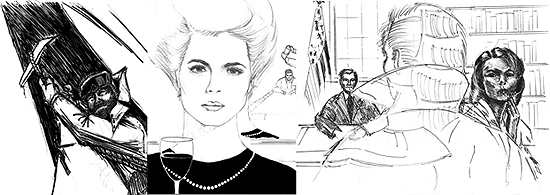
The McPain Conspiracy
By Sam Miller
INTRODUCTION: DI author/contributor “Sam Miller” (pseudonym of one of our regular DI band, electing for mystical reasons to remain anonymous) has graced us with a sequel to his previously co-authored “Chronicles of the Shade” (Part I) which you can still enjoy through the free books link to this website. Chronicles…Part II is—again—a DI exclusive.
It would be helpful—but not necessary—to read Chronicles I in order to enjoy this sequel, although it is recommended that the reader peruse at least Episode 1 of that earlier drama in order to better grasp the gist of the “Shade’s” mystical identity and modus operandum.
In this very insightful (and hopefully non-prophetic) sequel, the author takes us with him and our magus of stealth on the latter’s continued saga in quest of the truth behind our administration’s foreign and domestic policy machinations and shenanigans.
Sam Miller, as we, was apparently troubled in no small way to read recent reports of Hillary Clinton’s back-handed endorsement of McCain by her several-times repeated statements to the effect that she (Hillary) and McCain shared in common a wealth of political experience when compared to Obama.
In this parody of actual events, Miller entertains us while he stealthily urges us to ponder (along with other things) the possibilities –mostly treacherous—underlying Hillary Clinton’s recent actions.
DW DISCLAIMER:
The DW website and its editor, Bobby Dees, wish to make it clear and certain to all readers that this offering is strictly fiction, and a parody of reality at most, and that the views expressed or implied in this dramatic art do not necessarily reflect the political views of the DW website, Bobby Dees or DW contributors and staff.
Having said all that, it is my sincere hope and expectation that you will experience the same enjoyment—and wake-up-message of attention and alarm—I did in reading this piece, which shall be presented to you in a serial publication of 6 episodes, each to be posted on the DW website on successive Wednesdays beginning April 23, and concluding Wednesday, May 28, 2008.
Thanks, “Sam”, for a fun and provocative read, and best regards to all our DW contributors and readership.
Dusty (DW Foreign Policy Editor, Robert R. Schoch)
Episode 1-
September 2008
Simon Quintus McPain looked at himself in the full-length mirror, gave his best grimace, and walked out onto the stage of the Repugnican National Convention. The crowd, mostly dressed in red, white, and blue garb, rose from their seats with a ferocious roar of approval.
“Squintus! Squintus! Squintus!” the cheering mob shouted over and over again. Of course, they were not only referring to the elision of ‘S. Quintus’, the way McPain usually signed his given names, but also to his habit of narrowing his eyes before he mounted a verbal attack on some hapless adversary. Everyone remembered the way he skewered Slim Buzzert on “Know Your Press” when the latter had the temerity to question whether McPain was too old to run for president. “I was out killing hundreds of gooks with napalm before you were out of nappies, sonny,” snarled McPain, “and I’m not too old to do it all over again.”
Now Senator McPain was grinning at the crowd, his elbows bent and his hands in front of his body, a boxer’s stance. After dislocating his shoulders and his elbows when he ejected from his plane and his parachute landed in a tree, arthritis had set in and he could no longer straighten his arms. His outer appearance now matched the inner warrior that he was. “My friends,” he said, “My friends….” But his words did not carry over the din in the convention hall.
“Sing it, Squintus!” the crowd began to shout. “Sing it! Sing it! Sing it!”
Squintus McPain’s grin got even wider. He knew what they wanted. He began to move his elbows back and forth, as if he were punching a heavy bag. The crowd roared with anticipation, and then there were shushing noises as the mob sat back to be entertained.
“Bomb, bomb, bomb bomb Iroon,” began Squintus, to the “Barbara Ann” tune from Grease. Then again, louder, “Bomb, bomb, bomb bomb Iroon!” As he sang, Squintus kept his elbows moving back and forth, and the band behind the podium began to play Squintus McPain’s theme song. The crowd then began to join in, and the convention hall rocked as the Repugnican faithful joined the chorus of support for their new leader.
Lance Carter did not join in the fun. He was dressed conservatively in a blue suit and red tie, and he sat quietly behind a large-boned woman who wore a long, star-spangled dress and a tall, red and white striped hat, so that, except for lacking a beard, she reminded one of Uncle Sam. The woman was singing and waving her arms, and her eyes glistened behind the red, white, and blue harlequin glasses that she wore. Lance had been able to enter the convention hall by adopting his persona of The Shade, lowering his heart rate and slipping into a parallel universe from which he could move about unobserved—the result of his being trapped in an icy crevasse in Katmandu some seven years earlier, when he survived only by drifting into a state of suspended animation. Now, except for a lack of excess animation, he seemed like just another delegate to the grand Repugnican convention.
Two weeks earlier Lance had received a telephone call from his good friend and long-lost relative, Wilby Goode. Goode, an investigative reporter for the D.C. Post, was concerned about rumors that had surfaced about something big about to happen before the November 2008 election—something that would put the Repugnican Party back in power for at least another four years. Wilby was again seeking the aid of The Shade Detective Agency to discover whether there was any truth to the rumors—rumors of a plot designed to install Senator Squintus McPain as President of the United States, despite the will of the general public.
Now the crowd had quieted, waiting for the senator from New Texaco to address the convention. “My friends,” he began again, “My friends….” And then McPain launched into his favorite stump speech, the one about keeping Americans safe from the hordes of foreigners who hated our freedom and would stop at nothing to destroy us, hordes of terrorists sponsored by terrorist states that were designing nuclear weapons to launch upon our shores, masses of people who believed in a hate-filled religion that preached Satan’s message in wishing to rain destruction on the United States and all its allies. Only the Repugnican Party could save the nation, continued McPain. Only the Repugnican Party stood firm against the anti-life, relativist, weak-kneed, multi-cultural, communist-liberal supporters of the opposite political party. Only the Repugnican Party and its chosen standard bearer stood between civilization and chaos.
Lance Carter tuned out the droning words of McPain and ignored the punctuated applause that greeted his every sentence. I wonder what it would be like to be a Repugnican, he thought, what it would be like not to have a single creative thought and to react robotically to every emotion-drenched suggestion to use force against anyone with whom you disagreed. Lance quickly put away the thought. That mindless state might bring its simple pleasures, but, as John Stuart Mill said, better to be Socrates dissatisfied than a pig satisfied. The source of Lance’s present dissatisfaction was the mysterious way in which Senator McPain had been resurrected from a moribund candidacy to capture the nomination of the Repugnican Party.
Merely six months earlier, it appeared that the Repugicans would choose either Julie Ruliani or Marvin “Bat” Numnee as their nominee. Both were awash with cash—the former from law-and-order PACs, and the latter from deep pockets on Wall Street. McPain, on the other hand, had to borrow money to stay in the race. Then suddenly things changed. Ruliani went down in flames in Florida, and Numnee soon followed. McPain’s coffers were now overflowing, and he easily turned back the challenges of the Bible-thumping Jim Huckleberry and the dour Libertarian, Don Small. The question that bothered Wilby Goode, as it now puzzled Lance Carter, was where the money to revive McPain’s candidacy had come from, and whether there was any “deal” involved between McPain and his providers.
McPain was wrapping up his acceptance speech. He raised his hands as high as they would go, up to his ears, and allowed the applause of the Repugnican faithful to wash over him like a soothing balm. “Thank you, my friends,” he said, as the applause began to die down. “Thank you very much. Now on to victory in November!” Then McPain marched from the stage with a purposeful stride. As he did so, Lance Carter lowered his heart rate to a bare minimum in order to become The Shade, climbed the stairs to the stage, and followed Senator McPain to his dressing room.
The Shade was able to slip into the Senator’s dressing room in the convention hall just before McPain closed the door. With a start, The Shade recognized the other man in the room. It was none other than Ricardo “Shooter” Chancey, formerly the vice-president of the United States, who had resigned five months ago, supposedly for medical reasons. What on earth was Chancey doing here? It was rumored that McPain and Chancey did not like one another, largely because McPain was a war hero and Chancey was a draft-dodging conniver.
“Hello, Squintus,” said Chancey. The greeting was not loaded with affection.
“Hello to you, ‘Shooter’, replied McPain frostily. “Couldn’t wait to get here, could you?”
“I don’t like to waste time,” said Chancey. “You’ve now got what you wanted, and now your backers are calling in the chips.”
Squintus McPain wasn’t the sort to be cowed by an overweight has-been with an artificial heart. “You know what you can tell those backers, Chancey. You can tell them to shove it. While you’re at it, you can do some shoving yourself.”
Chancey gave McPain his best Sunday-school smirk. “Sure I will, Squintus. Anything to oblige our war hero. But you’ve got to know that what has been given can be taken away. You’ve got an uphill general election to fight, and you need all the help you can get.”
“So, what will you do, ‘Shooter’, decide to support Bam Orama? That guy can’t be bought any more than I can.”
Ricardo Chancey grimaced. The mention of Orama filled him with disgust. He wasn’t supposed to be the Demo nominee. That post was supposed to go to Hildegard Swinton, the darling of the unions and the one that all red-blooded, red-necked, gun-bearing white men had been taught to hate. All the Repugnican strategists had been savoring a campaign against Swinton so they could beat her like a drum. Chancey and the Repugnican elite had just not counted on the groundswell of support for Orama, especially from young people who were tired of the D.C. way of doing business.
Chancey decided to change tactics. “Look, Squintus. Nobody’s trying to buy you. We’re on the same side here. We both want what’s best for the country. You know, no gooks allowed? No letting other countries bully us with lame talk about human rights? We need to stand firm for the flag.”
As Chancey continued to try to pacify McPain, The Shade peered into the former’s mind, which was as convoluted as a Victorian maze. One thing stood out clearly, however, and that was Chancey’s conviction that only by controlling the world’s oil could the United States continue to expand its dominion over other nations. President Barnaby A. Liar was supposed to nail down the Jiraqi oil, but he had failed. The puppet government he had installed had refused to sign the oil agreements, and the big oil companies were getting restless. That was why they had funneled money into McPain’s candidacy, because they knew that Squintus McPain wanted to go to war with Iroon, and Iroon was the only place left with enough oil reserves to continue the reign of U.S. imperialism.
“Look, Squintus,” said Chancey. “We both know we need a war with Iroon to keep our defense-driven economy from sputtering out completely. B. A. was supposed to tackle Iroon after a cakewalk invasion of Jiraq, but he wasn’t up to the job. I hear that his wife won’t even let him have chocolates anymore.”
Squintus McPain chuckled. He’d never liked the draft-dodging bully who was now rumored to spend most of the time that remained of his presidential term sleeping on his sofa in the Elliptical Office of the Grey House. “So what are you saying, ‘Shooter’, that we form an alliance because of common interests?”
“You’ve got it, mister war hero. You’re the only one with the credibility to talk about using military muscle to further our national interest. Besides, you’ve got a score to settle with those gooks, don’t you?”
In saying this, Chancey was cleverly playing the race card, knowing that ever since his being shot down in a bombing raid over West Rattan, he had harbored a grudge against all non-Caucasians. Especially irritating was the thought that a sixteen-year-old kid hiding in a rice paddy had blown his A-4 out of the sky with a shoulder-held rocket launcher. Lucky shot, was the only thought that kept his spirits up during his six years of confinement in a West Rattan POW camp.
The Shade could see the conflict in Squintus McPain’s mind. On the one hand, he didn’t like anyone’s telling him what to do. On the other, he knew that he needed heavy financing in the coming election, because Bam Orama was raising millions on the Internet. Surely, he thought, he wouldn’t be compromising his principles—at least not too much—if he acceded to Chancey’s request.
Finally, Squintus McPain shrugged his shoulders and said, “Sure, why not. But there’s got to be a semblance of provocation before we launch an all-out war.”
Chancey gave McPain his best imitation of a sincere smile. “Of course, Squintus. But don’t you worry about that. I think there might be an October surprise that will dash all those peacenik hopes. Then we can get our country back on the right track—back to where nobody can mess with us.”
The Shade waited until Chancey opened the door to leave the room, and then he slipped out before Squintus McPain could close the door. This was serious, he thought. He would have to tell Wilby that there was indeed a plan to go to war with Iroon. Hopefully, the American public would not be gulled again.
Chronicles of the Shade Part II Episode 2
Comments are closed.