Chronicles of the Shade©*
Episode 9 –
The Speaker Decides to Act
August 2007
Wilby Goode sat cooling his heels in the outer office of the Speaker of the House of Representatives, the Honorable Fancy Bugliosi. His friend, Henry Stroyer, an old classmate from the Columbia School of Journalism, had arranged an interview for him. Wilby had made copies of the tapes and put them in his safe deposit box. In his briefcase were the two original tapes that The Shade had made for him.
As he waited, Wilby thought about the train of events that had led him to this point in history. He had come from a military family, stretching back to his great-grandfather, George Irving Goode, a West Point graduate who had served as an army officer in France during the Great War. George’s younger brother Billy had also served in that war as a sergeant, but in a different unit. When George returned home in 1918 he recounted to his family how he had met Billy in 1917 while the latter was on his way to the front and George was on his way to the rear lines. George and Billy had a riotous reunion, George having ordered his younger brother to put off going to the front and instead drink wine with him in a nearby French wine cellar. After drinking several bottles of wine and toasting General “Blackjack” Pershing countless times, the brothers parted company. Before they went their separate ways, however, they swore to meet again at the end of the war. Somewhat tipsy, George Goode insisted that they put it in writing; and so they did, with a young Frenchwoman serving as witness. G. I. Goode never saw his younger brother again. Billy was one of the last to be killed before the Armistice was signed, and George was demobilized and shipped back to the United States.
G. I. Goode was given a hero’s welcome when he returned to his west Texas home. One of those most happy to see him was Emily Parker, the local beauty who had waited anxiously for George’s return. They were married a year later and settled down to raise a family. Their second son, Donald Omar Goode, attended VMI and upon graduation served as an army field officer in World War II, winning the bronze star for gallantry in action. Returning safely home, D. O. Goode married Emily Peabody, the local schoolteacher. Their first-born, Parker Goode, piloted KC-135s during the Vietnam War. Parker married another Air Force officer, Sara, whom he had met while on R & R in Hong Kong. Their only child, Wilberforce B. (Wilby) Goode, was born in 1968, named for the man who in 1830 ended the slave trade in Great Britain. Both Parker and Sara Goode died in a tragic airplane crash in 1995. By that time, Wilby had already graduated from Texas A & M and was serving the last of his five years as an army officer. After that, Wilby was pretty much on his own. He attended Columbia University for a master’s degree in journalism, and he had been an investigative reporter ever since.
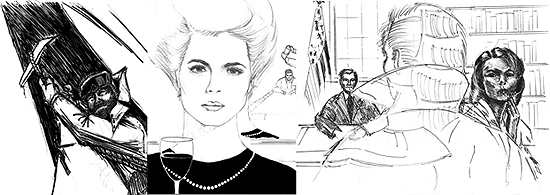
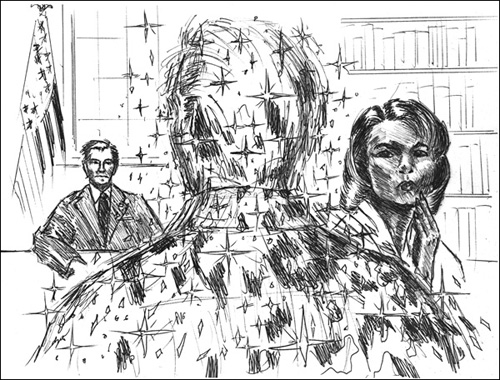
The door to the Speaker’s inner office opened, and Henry Stroyer beckoned for Wilby to enter. Fancy Bugliosi was standing behind a large, mahogany desk. She was wearing an elegantly cut, chocolate brown pants suit, and she was wearing a thin rope of braided gold around her neck. Her chestnut brown hair was perfectly coiffed, and her makeup had been applied with exceeding care. She extended her hand to Wilby and welcomed him with the words, “Hello, I’m Fancy Bugliosi. I understand that you want me to hear some tapes of yours.”
Wilby offered his hand, and he was surprised by the strength of the smooth little hand that gripped his own. “Um, yes,” said Wilby, “I’m Wilby Goode, and I think you will find that these tapes make interesting listening.” With that, he handed the tapes to Stroyer, who placed the first one in the tape machine and hit the play button.
Fancy Bugliosi listened to the first tape without a word. She changed expressions only once, when the President referred to the Speaker as an “Eye-talian American Princess.” When she heard that, she stuck her jaw out and tightened her lips. When the tape was over, she motioned for Stroyer to play the second tape. While the second tape played out the lugubrious romantic moment between Condo Spice and the President, the Speaker kept shaking her head from side to side, her mouth open in amazement.
When the second tape had ended, Bugliosi pushed a button on her intercom and snapped, “Get my legal in here, quick!” Then she turned to Wilby and inhaled slowly before saying, “Mr. Goode, I thank you for bringing this information to my attention. I can assure you that as Speaker of the House of Representatives that I will put it to good use. I assume that you’ve made copies of these tapes, so I hope you don’t mind if I keep them awhile.”
Because Wilby could see that the Speaker had not been asking a question, he said, “Of course, you may keep them as long as you like. I would like to know, however, what action you plan on taking, and I would be grateful if you would let me know as soon as you can.”
“Don’t worry, Mr. Goode,” said the Speaker. “I know that you’re an investigative reporter, and that you would like to publish a story based on these tapes. I must ask you, though, to hold off on any publication of what is in them until I find out what my legal team has to say. Be assured that I’ll let you know as soon as possible when and how you should release this information.” Then Fancy Bugliosi extended her hand to Wilby, and he knew that the interview was over.
As Wilby passed through the outer office, the Speaker’s legal team was coming in. The last words Wilby heard as he departed her office were those of Bugliosi: “I’ll show that little creep just how much of an Italian-American Princess I am!”
Wilby smiled. He knew that Fancy Bugliosi didn’t like to be crossed or taken lightly. She had come up through the political ranks, first as a councilwoman in a tough and mostly Italian-American California district, and then as Mayor of Mendocino. She had been elected to the House for four consecutive terms, and she was reputed to have very sharp elbows.
Wilby returned to his small apartment near the center of D.C. He had been living there for two years, ever since returning from an embedded position with the U.S. Marines in Jiraq, writing for the D.C. Post. What he saw of the war sickened him. He had written several exclusives showing how badly the war was progressing. When the last one was published, his unit’s military commander told him that his assignment had been terminated, and he returned to D.C. to do free-lance investigative reporting. His stories still occasionally appeared in the Post.
Wilby opened his refrigerator and took out a cold Budweiser. He popped the cap and took a long swig from the bottle. He didn’t know how long it would take for Fancy Bugliosi to let him know how she intended to use the tapes. Maybe he should just have given them to the Post. He wasn’t sure he could trust the Speaker to do the right thing, which, in his mind, was to set things in motion to impeach, convict, and imprison Liar, Chancey, and Lice. He shrugged his shoulders and took another swig from the beer bottle. He still had copies of the tapes. If Bugliosi did nothing, he could still have them published. He would have to wait.
Wilby wasn’t hungry. He took his beer to a small table and turned on his PC. He would forget about the tapes and concentrate on his unfinished novel. It told the story of a boy from a small, west Texas town who battled with large corporations for the soul of his country. He sat down to read what he had written. He tried to think of how to continue, but the words wouldn’t come. He sat there until late into the night, writing sentences and paragraphs, and then deleting them to start over again. He had completed only one page, when, finally exhausted, he turned off the PC and lay down, fully clothed, on his unmade bed and slept.
Next morning, Wilby awoke famished. He decided to jog down to a neighborhood café for breakfast. It was only a half-mile away. He put on his sweats and ran at a medium pace, breathing deeply of the cool morning air. After a full breakfast, Wilby bought a copy of the Post and walked to a nearby park and sat down on a bench to read it. When he returned to his apartment it was nearly noon. He showered, shaved, and put on a clean shirt and khakis. He brushed his close-cropped hair, grabbed his car keys, and prepared to leave for a scheduled interview with the director of a homeless shelter when the telephone rang.
A feminine voice on the other end of the line said, “Mr. Goode, would you hold for Speaker Bugliosi?” Wilby held his breath. His stomach tightened as he waited on the line. He hadn’t expected her to get back to him so soon.
“Mr. Goode?” said Fancy Bugliosi. “I have some news for you. I hope you will consider it good news.”
“Yes, Madam Speaker, I’m always in the market for good news.”
Wilby heard Bugliosi chuckle on the other end of the line. “Well, here’s the deal, if I might put it that way,” said the Speaker. Wilby inhaled sharply, but said nothing.
“After getting advice from my legal team, I played the tapes for the President’s Chief of Staff, Randy Cardigan,” said Bugliosi. “He was not amused. I told him to notify the President and his wife that this was how it would play out. I told him that there was an investigative reporter who would splash the transcripts of these tapes all over the national media if the President didn’t play ball, and that would ruin what was left of his presidency. The public would demand impeachment, and I’d have to put it at the front of the table.”
“What does playing ball involve?” asked Wilby, warily.
“Chancey resigns in a couple of weeks,” said the Speaker. His doctors confirm that it’s for medical reasons. Spice is gone by the end of the month, claiming that she has a great offer from Fayetteville State University to run their political science department.”
“What happens to the President?” asked Wilby.
“President Liar stays in place,” replied Bugliosi. “My lawyers tell me that there’s nothing on the tapes that the public doesn’t already know about him. They voted for him twice knowing he was an idiot, and the tapes only confirm that.”
Wilby felt the heat rising at the back of his neck. “So the President gets off the hook, and both Chancey and Spice leave office with their reputations intact? That miserable, smirking, draft-dodging bully just gets off?”
“Look, Mr. Goode, I know how you feel. I can’t stop you from publishing the tapes, but consider what is likely to happen if you do. They will circle the wagons and create a diversion that will probably result in starting another war. With both Chancey and Spice gone, and with Ada’s help, I can handle that little—what’s the best way to describe him? That little, addlebrained chocoholic?”
Wilby smiled in spite of himself, remembering The Shade’s description of the President’s devouring the candy kisses in the Elliptical Office. Then he said, “Aren’t you afraid that I’ll publish the tapes when Chancey and Spice leave?”
“I can’t stop you from publishing those tapes any time you please, Mr. Goode. But if you don’t wait until Liar leaves office, think of what it will do to my power and prestige in the House. I’ll be branded as a deal-breaker, and all the cockroaches will come out of the woodwork to destroy everything constructive I’ve got in the works.”
“What constructive things do you have in mind?”
“I can guarantee that if you take the deal, our troops will be out of Jiraq by next spring. There will be no war with Iroon, and the Repugnican Party will be scrambling to get on board with a sensible energy policy, universal health care, immigration reform, and a living wage for every citizen in our country.”
Wilby did not have to think about it long. “If I take the deal, am I then permitted to publish the tapes when Liar leaves office?”
“That’s it, Mr. Goode. Is there anyone besides you who knows about these tapes?”
“Only one person, and I trust that person implicitly.”
“OK, then. If you agree, we’ve got ourselves a deal. If I break it, then you may publish immediately. If you break it—well, then I guess that’s my problem, isn’t it?”
“You’ve got a deal, Madam Speaker,” said Wilby, “and you needn’t fear that I won’t keep my word. I’m an old Texas Aggie, and we always do what we say.”
“Mr. Goode,” said the Speaker warmly, “you have done a great service for your country. I’m sorry that it won’t be recognized—at least not now. I am profoundly grateful for what you have done for all our citizens. Goodbye, Mr. Goode, and good luck to you.”
Wilby put down the telephone. He exhaled deeply. His first impulse was to telephone The Shade and tell him the news. Then he decided that this news had to be imparted in person. He felt like rushing to his car and driving to The Shade’s office, but he was too excited. He would have to tell his story after he had calmed down. It would have to wait until tomorrow. Instead, Wilby turned on his PC and started to add to his novel. The words flowed easily from his keyboard onto the screen. He wrote until darkness fell; and then he turned up his lamp and wrote until his fingers cramped. Every word was just as he had conceived it in his mind.
As Wilby wrote, Lara was preparing for bed in her D.C. apartment several miles away. After eating a solitary dinner, she had read until nearly midnight. It was Volume I of Proust’s In Search of Lost Time (Du côté de chez Swann, translated by Lydia Davis). It was a demanding work, but its descriptions accurately captured what occurred within one’s secret soul. She could use these very insights in her own writing. It was time for bed, but Lara was restless. She didn’t think she could sleep, so she took an Ambien tablet before turning in.
She was asleep in minutes. Then she dreamed. She dreamed that Lance had telephoned her to say that he wanted to see her and give her a gift. She dreamed it was his Aunt Viva’s locket she was about to receive. He had told her the story of how Aunt Viva had bequeathed it to him. She dreamed of meeting him and rushing up to him and squeezing both his hands in hers.
“Oh, Lance,” she heard herself saying. “Just as your Aunt Viva wore this locket before me, and her mother before her, I will wear it over my heart as long as I live.”
In her dream she lifted her hair with both hands and turned for Lance to fasten the clasp. Then she turned again, radiant, her indigo eyes glistening with happiness as she took his hand and guided him to the mirror where they could admire the small, golden heart, now resting over her own heart. Then Lance took Lara into his arms. If this is a dream, she said to herself within her dream, I hope that I never awaken. What she saw was past and future merging in their tender embrace.
TO BE CONTINUED….
Next Week: Episode 10:
“The Circle is Completed”
Posted in Political | Comments Off
Chronicles of the Shade©*
Episode 8 –
Delivering the Goods
July 2007
Lance Carter waited in the inner office of his detective agency for the arrival of Wilby Goode. He had given Lucienne the day off because he wanted to play the tapes privately for Wilby. Lance arrived early for their appointment because he wanted to think about what he should recommend that Wilby do with the tapes. Clearly, they showed malfeasance in office by President Liar, Vice-President Chancey, and Secretary of State Spice. There was solid evidence for impeaching the first two and sacking the third.
As Lance waited for Wilby, his thoughts wandered back to his long and slow recovery from being buried in the ice. Except for minor frostbite, there were no physical signs of his ordeal. Yet he had suffered mental anguish. He knew that he loved Lara. But he also knew that two commandments had been given to him in the ice—two commandments that he felt had saved his life and that he must somehow honor. Those commandments were to preserve the union and to renounce the world. How could he fulfill both these commands? They seemed clearly contradictory. They were the thesis and antithesis of his being, and yet he could discover no synthesis to resolve their conflict in his mind.
It also took him a long time to puzzle out the rationale of his newly acquired powers. He found that simply by thinking about it, he could lower his heart rate so that his heart was barely beating and his blood pressure was nearly nonexistent. During such times as he practiced doing this, he became aware that people around him ignored his presence. It was as if they were living in a different world from his. It was only after reading the latest theories of an obscure professor of physics named Carl Shoenfeld that he hit upon the most rational explanation of his powers. According to Shoenfeld, in order to make sense of quantum mechanics, we had to postulate infinite parallel universes, each with its own time frame. When physical tests seemed to show that a sub-atomic particle was in two places at once, it was explicable on the basis of that particle’s having jumped briefly into a parallel universe and then back again. Lance reasoned that when he slowed his own bodily functions, he transported himself into another universe parallel to the normal one, and his bodily clock then operated differently from the bodily clocks of others. That was why no one noticed him when he was The Shade. It also explained why he could observe the inner workings of the minds of others; because, being in another universe, he was not affected by what was physical in the normal universe. The minds of others were transparent to him because there was nothing physical that blocked the pure energy emanating from their minds and flowing into his own.
There was a knock on his office door, and Lance welcomed Wilby Goode inside. “I’ve got your evidence on tape for you, Wilby,” he said. “The special box I had made prevented their being erased. It’s too bad that my first tape was destroyed, because that one was the most damning of them all.”
“I’m afraid we have to go with what we’ve got,” answered Wilby. “I told you how close we are to bombing Iroon.”
“I think there is still plenty of evidence,” said Lance, gesturing for Wilby to sit down. Lance then put the first tape in his machine and played it. When it was finished, Lance inserted the second tape and played that. During the playing of the tapes Wilby said nothing, but his mouth was set in a firm line. After the last tape had been played, Lance hit the rewind button and looked at Wilby questioningly. “Well,” said Lance, “what do you think?”
“I think,” said Wilby in a grim and determined voice, “that these people should be locked away and the key thrown in the Delaware River. Toward that end, I think that we should give these tapes to the D. C. Post and let them run the transcripts on the front page.”
Lance eased back in his swivel chair and looked at Wilby for a long moment. “They’re your tapes, Wilby,” he said, “and you may do with them what you wish; but I have another idea that you might consider.”
Wilby was silent, so Lance continued. “You want these people removed from office, yet if you go public with the tapes, they’ll have their lawyers fighting you and
The Post every step of the way. You might not be able to prove that the tapes are genuine. In the meantime they might simply go ahead and bomb Iroon, claim we’re at war, and assert executive privilege.
Wilby sagged in his chair. “What do you suggest, then?” he said.
“Do you think you can get an interview with Fancy Bugliosi?”
“You want me to get an appointment with the Speaker of the House?”
“Yes,” said Lance. “Think about it. She’s the third-ranking Federal officer. She controls any impeachment proceedings. She can get her legal team to figure out how best to use this evidence.”
Wilby rose from his chair. “I know her deputy, Hank Stroyer,” he said. “If I tell him what it’s about, I think I might be able to get in to see her.”
“Good,” said Lance, as Wilby turned towards the door. “Play the tapes for her and see what she says.” Lance put his hand on Wilby’s shoulder, and as they walked towards the outer office he gave Wilby the personal card containing his home telephone number. “Please telephone me at home, any time, and let me know what happened,” he said, as Wilby strode with a determined gait down the hall and out into the bright and warming summer afternoon.
Lance sat in his office for nearly an hour after Wilby had left. He hoped that he had given him good advice. He hoped that Fancy Bugliosi would do the right thing. Anyway, he thought, it was out of his hands now. He would just have to wait to see what the fates had in store. The Shade had done his part. Now it was up to players on a larger stage to move the action along. As he mused about the role he had played in trying to add some weight to the scales of justice, he remembered how far removed he had been from taking any such action a few short months ago.
After returning from Katmandu, he had waited a month before writing to Lara. His first impulse was to renounce the world. Having been left an enormous fortune from the estates of his mother and grandmother, he set about to renounce it all. He sold Viva’s Château. He sold his mother’s mansion. He sold his Cessna, his BMW convertible, and his Mercedes 500 SL. He cashed in all his stocks, bonds, and money market accounts. He put all the proceeds into a checking account and began writing checks. He wrote large checks to the World Wildlife Fund, to the Southern Poverty Law Center, to the Nature Conservancy, to Oxfam, and to countless other charities. He wrote checks until all the money was gone. He kept the 2001 Honda. He also kept his townhouse in Reagan, D.C. He thought about selling the condominium on Treasure Island, but he never got around to it. He kept it rented, instead. His father had set him up with a generous irrevocable trust, so he could easily live on that.
Finally, he wrote to Lara. They arranged to meet at “Liberties” in Philadelphia. Lance was nervous. How could he tell her that he had given his fortune away? Would she think he was crazy? That was not the real issue. She had never cared for excess wealth. How could he tell her that he had undergone the experience under the ice that he, at the time, could only think of as a mystical experience? Then she was sure to think he was insane.
Their first meeting in months did not go well. He kissed her warmly, but then he retreated into a shell. She was puzzled. She tried to draw him out. She tried to coax him to talk about his ordeal. He was reticent. He ordered champagne, their favorite, Dom Perignon. They toasted one another. She smiled her most charming, guileless smile and tried to get him to open his heart to her. He retreated. They talked pleasantries. He kept drinking. Finally, staggering slightly as he escorted her to the door, he called a cab, gave her a kiss that missed her mouth, and bade her goodnight. They would meet only twice more, the last being after his drunken ravings outside her home.
Lance couldn’t blame her for having left him. He was a mess. He had managed to drive the only one he had ever loved out of his life. He agonized over what he should do. Finally, he concluded that renouncing the world meant that he had to give up all thoughts of love and that he had to concentrate on preserving the union. That was when he decided to use his strange powers to serve the interests of justice. That was when he became The Shade. If he could do that, then maybe he would once again find himself worthy of Lara’s love and respect.
Lance turned off the light in his office and left the building. He didn’t know how well he would sleep that night. Thoughts of Lara and of Wilby crowded his mind. Perhaps he could trust himself to have two martinis before dinner.
TO BE CONTINUED….
Next Week: Episode 9:
“The Speaker Decides to Act”
Posted in Political | Comments Off
Chronicles of the Shade©*
Episode 7 –
Aunt Viva’s Locket
Late June 2007
Lance Carter sat brooding in front of his phonograph, swirling the lemon twist in his vodka and gin martini. Dinah Shore was singing “Blues in the Night” with Dizzy Gillespie’s orchestra playing in the background. Yes, he said to himself, in response to the lyrics, I’m the one singing the blues. He had spent a full day in the Elliptical Office and in the library of the Grey House searching for the hidden tape erasers. Fortunately, he’d had the premises to himself. President Liar was in Kansas preaching to the fast diminishing faithful, and Condo Spice was in Ragtad trying once more to raise false hopes for peace prospects in Jiraq. Ricardo Chancey was holed up in his bunker devising strategy for bombing Iroon with his new number one boy, Abe Elliott. Yet Lance had found nothing, and he finally concluded that it was hopeless. The tape-erasers had been embedded in the walls. There was no way that he could dig them out, and he therefore could see no way to remove intact the two tape recordings that he had secreted in the room.
A message had been waiting for him at his office, where he had stopped before returning home. It was from Wilby Goode, who said that it was urgent that the Shade provide him with evidence of the wrongdoing of Liar, Spice, and Chancey, and do it soon. Wilby had heard through a confidential source that the trio was planning to use “nucular” weapons on Iroon. Chancey was urging a quick strike, whereas Spice thought they should wait until they could cobble together some Middle East allies, such as Sudsy Aramia and Jurdeen. No matter what the time frame was, Wilby thought the attack was a done deal. He said that Senator Gramsey Linden, the wimpish head of the Senate Judiciary Committee, and Attorney General Ratoberto Gonsalves were right now conspiring to find a way to circumvent the Geneva Conventions. Wilby should know. After all, he was an investigative reporter with high-level sources within the Beltway. Lance sagged in his chair. He had let Wilby down. He had let Lara down. Most important, and most hurtful, he had let himself down. He thought that with his power to glide unnoticed through the halls of the mighty he could uncover wrongdoing and make it known to others. He had failed. He was a failure.
He tried to rouse himself from his funk by thinking of happier days. The martini was beginning to warm his body, and he took Aunt Viva’s golden locket from his shirt pocket and opened it. From it he took the carefully folded scrap of paper and looked at the three words penned there, and the two sets of initials beneath them. He remembered when Aunt Viva had first shown him the locket. Her mother, Vérité L’Amour,
had bequeathed it to her along with its contents. Vérité had told Viva that an American army lieutenant had given it to her for safekeeping, but he had never returned after the Great War ended to retrieve it. Neither Viva nor her mother knew what the words meant, but they treasured the keepsake as a memento of the 1918 liberation of France.
Upon graduating from Farragut Academy at age 17, Lance had taken a year off to visit his Aunt Viva in France. Lance’s mother thought it would be good for the boy to broaden his experience; and, truth be told, Lance’s mother found his presence awkward for her because, except for summers, he had spent his entire school career at the austere Academy nestled off the Florida Intracoastal, and he seemed almost a stranger to her. Aunt Viva, on the other hand, desperately wanted to see the boy, and she pleaded with his mother until the trip was arranged.
Aunt Viva met him at the Charles de Gaulle airport in Paris. Her flaming red hair told Lance immediately that it was she erupting from the crowd around the gate towards him, with arms outstretched and a broad smile enlivening her face. «Mon petit garçon!» she exclaimed, and then, upon looking up at him, added with a laugh, “No, not so small at all!” She hugged him tight. Then she turned and waved her arm, saying, «Allons-y! Allons-y!»; and then they were off to her château.
Mother had said that Aunt Viva was a madcap. She had not exaggerated. In addition to being a fine horsewoman, Viva was an expert balloonist. On weekends she would take Lance up in her hot-air balloon, and they would float over the countryside. Frequently, she would rendezvous with other balloonists and skim with them over the landscape—gliding, soaring, and dipping as they adjusted the burners under their balloons. One such morning, as Lance looked about him, he saw myriad, bright dots of color languidly rising like party bubbles in the liquid blue sky. Then Viva adjusted her burners and they drifted above all the rest, higher and higher into the cooling air.
When they had risen far above the other balloons, Viva shouted over the blast of the burners, “I want you to hear something. But you must remember to be perfectly still and not say a word.” With that, Viva turned off the burners. Then she extinguished the pilot light. Her green eyes were riveted on his; that and her tousled, red hair made her look, as he now recalled, just like Lauren Holly. After only a few seconds he heard the unimaginable: it was the sound of silence. Viva’s silver laughter broke the stillness. “Yes?” she said.
Lance replied, “Yes, oh yes! It’s wonderful!”
“So, now we return to the world,” Viva spoke as though to herself. Then, as she took the butane lighter from her jacket pocket, she smiled at Lance, tilting her head to the right, as was her charming habit, so that one long flame of red curl rested at the center of her forehead, “That is, if I can get the pilot light lit again!” She again laughed that silvery laugh and lit the pilot, and the burners roared into life. As they drifted slowly to earth, she opened the locket and showed Lance its contents.
“What does it mean?” Lance said.
“I don’t know,” said Viva, snapping the locket shut. “I know I can tell you only this, dear boy: when I die, you shall have this locket. Viva looked deeply into his eyes, showing something in her gaze that bordered on some half-remembered sadness. “It was given to me by my mother, and it was given to her by an American. Because you are American, you should have the locket.”
Lance was caught up short in his reverie by remembering Viva’s promise of long ago. His sojourn in France had ended all too early. A year went by and he was back in the United States. Although they exchanged letters frequently, he never saw Viva again. After his four years at Princeton—his mother having died suddenly during his junior year—and after another three years in the army where he had gone to OCS and served as an intelligence officer, Lance was recruited by the Agency at Langley, where he spent a miserable two years. He had been profoundly disappointed by the Agency’s practices, so he resigned and took over his father’s seat on the Stock Exchange. Eighteen months there were enough; so his restless journey took him to Wyoming, where he bought and operated a cattle ranch. After three, hard-working years, Lance decided that he really wanted to spend his time doing research in history and political theory. He applied for an M.Phil. at Oxford, and, thanks to his good undergraduate record, he was accepted as a mature student at age 34. Two years later, as he was putting the finishing touches on his thesis, a letter arrived from Viva. She wanted him to accompany her on a mountain-climbing trip to the Himalayas after he finished his degree. At the time, he was deeply involved with Lara, but he told her that he wanted to see Aunt Viva again. She had to be nearly 80 years old, still taking risks, and this might be Lance’s last opportunity to visit her. Lance told Lara that he would meet her in Philadelphia that very summer.
Fate intervened. Lance was only weeks short of finishing his thesis when he heard that Aunt Viva had died. Viva’s balloon had drifted over the English Channel in a heavy fog when an RAF fighter flying out of Brize Norton clipped her orange and green balloon and sent her tumbling out of her basket into the cold waters of the Channel. A nearby fishing boat had retrieved her lifeless body from the water. She was still wearing her golden locket.
Lara understood when Lance told her that he had to leave immediately for France. He attended the somber funeral, attended by all Viva’s friends and fellow balloonists. He learned that he was the sole beneficiary of her will. Except for a monetary settlement to a few of her retainers, Lance had inherited everything—the château, the savings accounts, the stocks and bonds—everything. Lance was disconsolate. All he wanted was to have Aunt Viva back. Yet at the reading of the will, Lance learned a curious thing. He had thought that Aunt Viva was his mother’s older sister. This was not true. Aunt Viva was actually his grandmother. Vérité L’Amour was given with child by an American military officer, who later left France. Viva was their daughter. Always a precocious child, Viva took an itinerant gypsy as a lover at age 15, and the result was a daughter—Stella. At age 16, Stella was swept off her feet by an American businessman on holiday in France—Stanley Noland Carter. Stanley was the seventh and last son of a full-blooded Blackfoot Indian, Lancelot Stanley Carter, and an Oklahoma cattleman’s daughter. The other six sons inherited land whereas Stanley was left with none. Hence, the name “Noland.” Stanley, however, had business acumen, and he parlayed that into a fortune in the stock market. Viva allowed Stanley Carter to take her daughter to the United States, where Stella gave birth to Lancelot Stanley Carter, II.
Lance pondered all this as he sat in his Reagan, D.C. townhouse, toying with the locket Aunt Viva had left to him. He read the words on the paper again: “Preserve the Union.” How could he do this? How could he preserve the union? His powers had failed him. Then he remembered Aunt Viva’s words to him: “You are an American. You should have the locket.” Yes, he though, he was an American. He possessed American ingenuity, just as his father had. There must be a way.
Then it came to him, as simple as the turning of a key in a lock. He searched his telephone directory for the number of a metallurgist friend. Then he dialed the number. “Hello,” he said, when the call was answered. “This is Lance Carter, and I have a request to make of you.”
TO BE CONTINUED….
Next Week: Episode 8:
“Delivering the Goods”
Posted in Political | Comments Off
Chronicles of the Shade©*
Episode 6 –
Melancholy Thoughts
Mid June 2007
Lance Carter awoke with a slight headache. He hadn’t meant to open the bottle of Rothschild Lafitte ’94, only the sixth out of the two cases he had bought at auction in 1998. At $100 it had been a fair price, but he had originally hoped to save it for a more auspicious occasion. The thought of Lara, however, and his memory of how she had shared his love for fine wine, prompted him to open the bottle. Now he was chagrined to recall that he had drunk it all. This wasn’t like him. After he had opened his detective agency, he had drunk only moderately—an occasional vodka and gin martini (2 parts Absolut vodka, 1 part Bombay Blue Sapphire gin, and 1 part Stock dry vermouth—with a twist of lemon). Yet he had felt that he needed a fine wine to complement the prime Porterhouse that he had decided to select from his stainless steel food locker.
Now he was annoyed with himself. He was revolted by the thought of returning to the former dissolute life he had led upon returning from Katmandu. He had a sworn purpose to fulfill—to fight the evils he saw in people’s minds, even though he seemed powerless to take punitive action himself. As a detective, he would have made Sam Spade and Mike Hammer laugh. He didn’t even own a gun. Although he had excelled in marksmanship at the Academy pistol and rifle club, he knew that he would draw the line at killing another human being. His two-year stint at Langley had convinced him that he was not cut out for operations that involved the assassination of foreign rivals. The eighteen months he had spent in his father’s seat on the Stock Exchange were disappointing, as were the three years he had spent running a cattle ranch in Wyoming. That was when he had decided, as a mature student, to pursue the M.Phil. at Oxford.
His annoyance was now tinged with sadness. He knew that during the previous evening he had begun to feel sorry for himself. His witnessing the brief romantic interlude between the President and Condominium Lice—well, as romantic as you could expect from those two—had brought home to him in a rush what he had been missing in his life. The words of Lord Byron echoed in his mind: “I fall upon the thorns of life, I bleed!” This melancholy had really begun when his father died and Lance was only ten. Lance was being boarded at the Farragut Academy in Florida when Stanley Noland Carter suffered a massive heart attack on the floor of the Securities and Exchange Commission, his last words being the strident shout, “Up another eighth!” Thus ended the career of the most remarkable hedge fund trader in history, surpassing even George Soros in the accumulation of wealth.
Lance’s mother had been devastated. Stella L’Amour Carter had never been a strong woman, and she had leaned on her husband in all things. Lance was summoned home for the funeral, but immediately afterward he was sent back to the Academy. Though never in want for anything, Lance had always felt strangely empty. Although he was a quick study, his grades had suffered after his father’s death, and he became introverted. His friends were few, and he began reading Greek mythology and delving into tales of the Norse gods and goddesses.
When he was ready for high school, his mother—still in mourning—had returned him to Farragut Academy and its strict military discipline. Lance learned to develop a tough exterior to mask the inward pain he was feeling. His grades improved, but he was not committed to his studies. He excelled at only those subjects that interested him. He began to read Dosoyevski, and then the works of Camus and Sartre. He tried out for varsity football and made the first team in his junior year as a cornerback. Fearless, and always a swift runner, he led the team in tackles until his knee exploded from the impact of an illegal block. He had been unable to play his senior year. Instead, he embarked on a brief yet torrid love affair—his first—with a vivacious and experienced young lady who attended a nearby Catholic girls’ school. When the affair ended—she having run off with a local businessman—Lance suffered the misery that comes only to those who have loved passionately, yet all too soon.
Now Lance began preparations for brewing some coffee in his sun-filled kitchen. He ground the coffee beans as the morning light streamed in through the windows and onto the polished antique furniture that he collected as a hobby. He popped a couple of aspirin in his mouth and washed them down with orange juice. Then he poured two ounces of MonaVie into a shot glass and drank the nectar distilled mainly from the potent açai berry. Funny, he thought to himself, he hadn’t thought about the auburn-haired Theresa in years. Yet it was her leaving him that had set him on the track of pursuing his studies with a vengeance. Upon graduation, and with some help from his father’s friends, he was admitted to Princeton. Four years later he graduated cum laude with a dual major in history and English. Before entering university, he had taken time off to spend a glorious year with his Aunt Viva in Nancy, France. She had shown him Paris, took him up in her hot-air balloon, and supervised his flying lessons. It was Aunt Viva who had nurtured his French, told him stories of the wonderful Josephine Baker, and taught him to appreciate blank-verse poetry and American jazz. It was she who told him to read Ralph Ellison’s Invisible Man and Richard Wright’s Black Boy. It was shortly after he had earned his pilot’s license that he received word of his mother’s untimely death and was forced to return to America. He never saw his Aunt Viva alive again, but he would remember her always. He saw her frequently in his dreams.
But it wasn’t thoughts of Theresa or Viva that had brought on Lance’s latest bout of melancholy. It was thoughts of Lara. Lara’s mother had named her for the heroine of Pasternak’s Dr. Zhivago—the book, not the film; for the slim, athletic, dark-haired Lara looked nothing like Julie Christie. Even now, as he savored the rich black coffee, he felt the pain of her absence. He wanted to find her—that would be easy enough—and he wanted to telephone her, wherever she was; but he knew that it would be too difficult. How could he describe to her the ennui he experienced? Worse yet, how could he overcome his embarrassment at remembering how she had found him six years ago, drunk as a lord, on the pavement in front of her Society Hill home? She had dragged him inside, sobered him up, but told him in no uncertain terms how things stood. She could no longer be a witness to the destruction of his life. She had no intention of preserving a relationship that he no longer seemed to care about. Then she had told him to leave—yes, with tears in her eyes, but with a firmness in her voice that would brook no excuses and no pitiful entreaties. He couldn’t tell her about his experience in the icy crevasse. It was too awful. He dared not tell her about his strange powers—especially the power to see into people’s minds. That would drive her away forever. Yet he held the hope that someday he would find the courage to tell her what he had become. Perhaps they would be able to overcome it. Perhaps they could work together to try to make the world better. “Too dangerous,” Lance said in a whisper. “It would be too dangerous to tell Lara what I am doing now.” Yet buried beneath his consciousness was the thought that what he was doing now was the result of Lara’s influence. In some secret place in his heart he knew that he was doing it for her.
What Lance Carter was doing at the moment was preparing to become his alter ego, The Shade. He had telephoned his office to tell Lucienne that he was not feeling well and was not coming in today. There were no messages. He was presently reconnoitering the premises of The Grey House. He was intent on making progress in disabling the tape erasers that “Quicky Slick” Piston had installed in the Elliptical Office. Like the shade that he was, he glided past the security guard and entered the Grey House.
TO BE CONTINUED….
Next Week: Episode 7:
“Aunt Viva’s Locket”
Posted in Political | Comments Off
Chronicles of the Shade©*
Episode 5 –
Remembrance of Things Past
Mid June 2007.
Lancelot Stanley Carter, II sat at late afternoon in his Reagan, D. C. townhouse, thoughtfully sipping his Gen Levitt single-malt Scotch as he listened to Billie Holliday sing “Am I Blue” on his old RCA Victrola. Although he had a state-of-the-art Bose sound system, he preferred listening to his old 33-RPM records on the Victrola because it sounded more authentic. The western sun streamed through the tall windows and burnished the mahogany wainscoting that covered every room. As he swirled the amber liquid in his glass, listening to the soft tinkling of the ice, he reviewed in his mind how he had spent the day.
He had awakened early, showered and shaved, and then driven his 2001 black Honda Accord to his gymnasium, where he had worked out on the treadmill and the elliptical machine for exactly an hour. He had then breakfasted at his favorite restaurant, the “Brasserie,” ordering two eggs over easy, wheat toast, and black coffee. Then it was time to visit his office, The Shade Detective Agency, where his secretary, Lucienne, greeted him with a smile.
“Bonjour, Monsieur Carter,” said Lucienne, pronouncing his surname “Car-tay.”
“Bonjour, Lucienne,” replied Carter, “Comment ça va?”
“Ça va,” said Lucienne, as she returned to her typing.
Lance Carter knew that today he had to return to the Elliptical Office. He again had to assume the persona of The Shade. He had promised Wil B. Goode—in his mind he now thought of him as “Wilby”—that he would overcome the obstacle of the hidden tape erasers and deliver evidence of wrongdoing by the most powerful people in the world. He briefly scanned his mail—nothing of importance—and he made ready to leave.
“I’m going to visit a client, Lucienne,” he said, as he passed through his outer office. “If anyone calls, say that I probably won’t return until tomorrow.”
“Très bien, Monsieur Carter,” said Lucienne sweetly. “Au revoir.”
“Au revoir,” replied Carter, thinking how lucky he had been to hire Lucienne, who was the daughter of a good friend of his Aunt Viva. Dear Aunt Viva, how he missed her. When Lucienne had decided to leave Nancy, France, and come to Reagan, D.C., her mother had written to Carter about employment; and he had hired her sight unseen. Although she spoke perfect English, and could type 95 words a minute, he encouraged her to speak French so that he could practice his own linguistic skills. He recalled with delight the year he had spent with Aunt Viva in France—some of the happiest days of his life.
During the time it took to walk from the parking garage to the Grey House, Lance Carter had become The Shade. He easily slipped by the guards at the gate and stood outside the double doors of the Elliptical Office. He tried the door handle. The door was unlocked, and The Shade eased into the office of the most powerful person in the world. The office was empty, so The Shade set himself to discover the location of the hidden tape erasers.
Suddenly the doors to the Elliptical Office opened, and The Shade backed into a corner, seeming to fade into the paneled woodwork. President B. A. Liar slowly entered his office, sighing noticeably. “What am I gonna do?” he mumbled. “Just what am I gonna do?”
The President slumped into the chair behind his huge glass-topped desk and put his head in his hands. He hunched his shoulders and let out a loud sigh. “Awww,” he groaned, “sometimes I almost think it ain’t worth it bein’ the decider.”
Just then another person entered the room. It was Condominium Spice, his Secretary of State, B. A. and M. A. from the University of Chicago, where she was Phi Beta Kappa, and Ph.D. from Yale. She had written her dissertation on the use of tactical atomic weapons to subdue recalcitrant states. Between obtaining her undergraduate and graduate degrees, Ms. Spice had also studied at Julliard, where she had won the grand competition with her performance of Rachmanivov’s second piano concerto. Fire and ice, but mostly ice, said the judges in granting her first prize. Dr. Spice had been President of the Colorado School of Mines before being selected for B. A. Liar’s cabinet.
The Shade was well aware of Ms. Spice’s intelligence and artistic qualifications. After all, she had won her prize playing one of his favorite pieces. He could also see into her heart, which was as black as her hooded, cobra-like eyes; and he could also see that her prime motivating force was a driving, naked ambition. The Shade watched as Ms. Spice moved behind the President’s desk and put her hand on his shoulder. “What is it, Mr. President?” she said, “Why so glum?”
“Aw, Condo, you don’t know how hard…how hard it is to make decisions. But that’s all I get. Decide this. Decide that. Now I don’t know what to decide.”
“Perhaps I can help,” said Condo, moving her hand from his shoulder to rest it lightly on his neck. “What is it you have to decide?”
“Aw, well, first the Joint Chiefs of Staff say that our military ain’t any good at this guerrilla warfare. What they need to do is to go out there and bomb the stuffings out of some country. That way we can show that nobody can mess around with us.”
“So, Mr. President,” said Condo soothingly, as she began to massage his neck. “Why don’t you just decide to bomb the so-called “stuffings” out of Iroon?”
“Oh, that feels good, Condo. I got myself a heap of a headache. But it ain’t so easy. That leader of Iroon, that Imadimeajob, starts talking peace, peace. How are we gonna bomb ‘em when they’re doin’ things like that?”
“Mr. President,” said Condo, as she began to massage the President’s neck and shoulders in earnest, “you must remember that Iroon is trying to get its oil pegged to the euro, not our dollar. If they do that, then other countries will follow suit. So our dollar won’t be worth anything anymore; and Chinosa and Nippona will stop buying our treasury notes. If that happens, then the jig is up. The country will sink into a deep economic depression, and our great Repugnican Party will never be in power again.”
“So what you’re sayin’, Condo, is go ahead and bomb ‘em?”
“That’s right, Mr. President. It’s simple,” said Condo, continuing her massage. “Remember, I wrote my dissertation on constructive bombing. We’ll just get the media on board and fool everyone just as we did about invading Jiraq. You just keep saying you won’t bomb them until you do it.”
As she rubbed the President’s neck and shoulders, The Shade peered into her mind. Condo Spice was thinking that if only she could gain the President’s confidence completely she could do so much with him. She could take his empty slate and write her own story on it. She would take him to see opera in San Francisco. She would show him the wonders of the Louvre. She would teach him how to say “nuclear.” Most important, she would have him making a wonderful speech nominating her for President of the United States.
“Oh,” said Condo, carried away by her emotion. “Oh, Barnaby, Barnaby, what a good team we would make.” She had used the President’s given name, something only a select few felt privileged to do. Her hands left the President’s neck and began caressing his stubbled cheeks.
“Hey, what’s up, Condo?” said the President, giving an involuntary start. “Why’d you quit rubbing my neck?”
“I just said that we would make a great team,” said Condo, removing her hands from his face. “What’s wrong with that? Just you and me. Can’t you see how wonderful that could be? Just you and me against the world?”
“Whoa, now, Condo,” said the President. “You ain’t talkin’ about any massage-a-nation, are you?”
“That’s miscegenation, Mr. President,” said Condo, reverting to her official demeanor. “No, we don’t worry about such things anymore. I just want you to think about it, that’s all. Just remember, go ahead and bomb Iroon when you think it’s time. You’ll feel good about it the next morning.”
With that final comment, Condo Spice was out the door, leaving the President alone with The Shade. As The Shade peered into B. A. Liar’s mind, he could first see nothing—just a vast emptiness. But then there was a flicker of emotion as the President said, under his breath, “I wonder if ol’ Condo can handle a chain saw. That’d be good.”
The President then put his head on his desk and began to snore. The Shade saw that he would not be able to search the Elliptical Office any further that day, and so he had left for home.
Now, as Lance Carter sat with his feet propped up on his glass-topped coffee table, he noticed that the Billie Holiday recording had ended. He rose from his recliner and put on an album featuring Anita O’Day singing Cole Porter. As the solid sound of Billy May filled the room, O’Day began singing “Love for Sale.” This song always filled Lance Carter with sadness.
He took the golden locket his Aunt Viva had bequeathed him from his shirt pocket and began to rub it absently. He thought of Lara, of the brief but wonderful time they had when he was studying for the M.Phil at Oxford. He had taken a trip to London to go pub-crawling, and he had met her at The Red Lion Inn. She was reading economics at the LSE, and she would be in England for only the Michaelmas term. He was smitten with her, and she apparently with him. He now pictured in his mind her lustrous, dark hair and her easy smile. He remembered her quick wit and her keen judgment.
He had never finished his thesis for the M.Phil. His Aunt Viva had died suddenly, and he had to leave for France to attend the funeral. He had promised to meet Lara in Philadelphia after returning from the mountain-climbing trip arranged by Aunt Viva’s French friends. He did return, and he did see Lara; but the time he had spent frozen in the ice had changed him into The Shade. He gazed at the golden locket, holding it up to the light. It had been found clutched in his hand when a local Sherpa guide had freed him from the ice. Ah, Lara, Lara, he said to himself as he toyed with the locket, my beautiful, precious Lara. Where are you now? He remembered the words of the poem. She walks in beauty like the night….
TO BE CONTINUED….
Next Week: Episode 6:
“Melancholy Thoughts”
Posted in Political | Comments Off
Chronicles of the Shade©*
Episode 4 -
“The Veep Weighs In”
June 2007.
Once again The Shade stood in the doorway to the private library adjacent to the Elliptical Office of the Grey House. He had been moved by Wil B. Goode’s entreaties to gather more evidence about the motives of those in power. The tape that he had delivered to Goode a month earlier had been blank! Goode had figured out why. Unbeknownst to all but a select few, President Ruston “Quicky Slick” Piston had installed tape erasers at each exit from the Elliptical Office and the library. Piston had wanted editing and copyright advantages over his own productions. He didn’t trust “all the President’s men” who were rushing to publish their stories before he could. Ergo, The Shade had to find a place inside the Elliptical Office in which to hide the evidence until such time as he could discover and neutralize Piston’s tape erasers. The Shade would have to spend time there alone.
As he was about to slip into the library, The Shade barely escaped colliding with a dynamo of a woman who was storming out of the library, chestnut curls bouncing as she flounced through the doorway.
“I don’t care how much it costs,” shouted Fancy Bugliosi as she brushed by The Shade, “the airplane was part of the deal! You get me my plane, or else impeachment gets put back on the table!” With that, the Speaker of the House of Representatives was out the door and gone.
The Shade slipped into the library and saw that both President Liar and Secretary Spice were staring open-mouthed at one another. He turned on his tape recorder.
“Well, I never,” said Ms. Spice. “Why can’t she act like a lady?”
“Aw,” said the President, “she’s one of them EAPs. I know how to handle her. All she needs is a little sweet-talkin’. But she sure isn’t like my Ada.”
Condo Spice knew that Mrs. Ada Liar had held his hand when he had undergone rehabilitation from cocaine abuse. She also thought that Mrs. Liar was one big, phony plastic woman who got a lot of mileage from her brief stint as a teacher. There was simply no comparison, thought Condo: I was a university president, and Ada can’t even play chopsticks on the piano.
“What’s an EAP, Mr. President?” asked Ms. Spice, ignoring the President’s mention of his wife.
“You know, Condo. It’s one of them Eye-talian American Princesses. Boy do they need to be pampered.”
“Um, I think that should be IAP, Mr. President,” said Condo.
“Whatever,” replied the President, “I can’t think about her right now. I got my veep comin’ over to see me. I asked him to meet me here.”
The President, The Shade knew, was referring to Ricardo “Shooter” Chancey, the Vice-president of the United States. Chancey rarely left his office. Ever since the hunting accident he had become more reclusive than ever. Fortunately, none of the hunting party had been killed when Chancey started shooting indiscriminately at anything that moved, but there had been a lot of birdshot plucked from the derrières of many prominent Texans on that unhappy evening.
“Do you want me to leave, Mr. President?” asked Ms. Spice.
“Naw, you stay, Condo. It sorta gives me the creeps to be alone in the same room with ol’ Shooter—especially since we had that, what did you call it? Thathallucigenation here last month.”
“That’s hallucination, Mr. President, said Condo, as she recalled with a shudder that totally disagreeable experience with The Shade. “But I told you that it was the paté we ate at that going-away party for Ron Dumsfeld.” Dumsfeld was the outgoing Defense Department Chairman who had ordered too many toilet seats for his soldiers in Jiraq, but not any body armor.
“Yeah, we shoulda’ stuck with the cheese dip,” said the President glumly, looking at his Mickey Mouse watch. “Say, ol’ Shooter should be here by now.”
As The Shade eased his way behind the drapes, he noticed that the room had suddenly become darker, and he thought he caught a whiff of sulphur in the air. He also noticed a slight clicking sound as the ponderous bulk of Ricardo “Shooter” Chancey lurched through the doorway. After his third heart attack, doctors had installed the latest Jarvik metallic model in his chest. It was a top-of-the-line J-23, guaranteed not to rust, and the ticking sound was barely audible.
“Hey, there, B.A.,” announced the veep with a sneer. “You, too, Condo. What have you two been up to here all alone?”
Condo Spice fixed a cold stare on Chancey with her coal-black eyes. She thought to herself how annoying the veep could be. Here he was, just a gofer who had climbed over the warm bodies of others more talented than he, and now he was the second-most powerful man in the world. She just hated it when he insinuated that there was some sort of hanky-panky going on between her and the President.
“Good morning, Ricardo,” said Condo with an icy smile. It’s good to see you up and about again.”
“Save the pleasantries, Condo. You know why I’m here, don’t you?”
“I haven’t the foggiest,” said Condo. “Is it because your approval ratings have dipped into the minus territory?”
“Ha, ha,” replied the veep mirthlessly. “You know I don’t care about ratings. I just want to get the job done. It’s a pity that the press won’t buy my line anymore about the progress we’re making in Jiraq. You’ve got to do more to back me up, B. A. No more of this nonsense about mistakes having been made.”
“Well, Shooter,” said the President nervously. “I’ve been up to my eyeballs reading all these newspapers with Condo here. Stoney what’s-his-name says I got to say what the public wants to hear.”
“Pfaff,” grunted the veep. “who cares what they think. We’ve got the executive power here, and we’ve got to use it. We’ve got to tell people how it is, and they’ve got to swallow it—wiretapping, secret prisons, waterboarding—it’s all a matter of executive privilege.”
The Shade resisted the urge to give Chancey a verbal blast that would send his Jarvik-23 into overdrive. But he had to keep silent so that he could gather more evidence and find out where those hidden tape erasers were.
“But enough of this,” said Chancey with an exasperated tone. “B. A. knows why I’m here, don’t you, B.A.?”
“Um, yeah,” said the President. “You see, Condo, Shooter wanted to talk to me about what happened to his number one boy. You know, Chester Glibby. Maybe you could stay awhile and help us out on this.”
Condo shrugged her shoulders. Yes, she knew all about Glibby. That blabbermouth had really messed things up, she thought, talking to all those reporters and not keeping his story straight. “Yes, Mr. President,” she said, “I’ll stay if you want me to.”
“What I want to know,” said the veep grimly, ignoring Condo’s presence, “is whether you’re going to get Glibby off the hot seat. He took one for the team, and you’ve got to make sure he gets pardoned if he’s found guilty after all his appeals run out.”
“Well, I don’t know, Shooter,” said the President. “It’ll look kinda funny if I pardon him after he’s been convicted of lying about who outed that CIA agent.”
“That’s irrelevant, B. A.,” said the veep. “You can do anything I say you can do. You’re the decider, the commander-in-chief, the war-on-terror president. Anyway, Glibby shouldn’t have been the one to scapegoat. He’s a darn sight smarter than Cal Stove. Stove should have been the one to go.”
The President glanced over at Condo Spice, blinking rapidly. She knew that this was a sign of his nervous disorder. He needed help before he started foaming at the mouth. Even now some tell-tale spittle had begun to form in the corners of his lips.
“Now, now,” Mr. Chancy,” said Condo in her best school-teaching manner. “We all know that Mr. Stove had an election to manage. We couldn’t let him get thrown to the wolves.”
“Oh, yes,” sneered the veep, “we know how well he managed that election. We lost both houses of Congress because he couldn’t tell a red state from a blue one. He’s lost his touch. ‘Liar’s brain’ indeed. He hasn’t got half the smarts of Glibby.”
“Well, it’s too late to cry about that, Mr. Vice-president,” said Condo soothingly. “You can be sure that we’ll do something about poor Chester when the time comes. Oh, would you like to have some tea? The President and I usually have tea in mid-morning.”
“Tea? No, that’s a sissy drink. I drink beer. But I bet you don’t have any beer around here, do you? I don’t see any refrigerator in here.”
With a swift glance around the room, Chancey saw that indeed there wasn’t any refrigerator there. Then he turned and moved his considerable bulk towards the door. “Got to go,” he said, “but you remember what I said. You back down when you’re attacked and you’re dog meat. Just get Glibby off the hook.”
Then the Vice-president was gone, and the room seemed to lighten by at least 10 watts. Condo took a handkerchief from her purse and dabbed at the President’s lips. “There, now,” she said comfortingly, “he’s gone. We just won’t worry about Chester until we need to. Perhaps you should commute his jail sentence and have your campaign donors pay his fine. You can give him a full pardon before you leave office.”
“Just fix me some tea, please, Condo,” said the President wearily. “I just got to think about goin’ to Crawdad this weekend and cuttin’ some wood.”
“Everything will be all right, Mr. President,” said Condo brightly. “Just think happy thoughts while I fix you some tea.”
The Shade turned off his tape recorder and placed it behind a picture frame. His encounter with the Vice-president had put a strain on his powers. Experiencing such unremitting, petty evil was difficult, and there was also that incessant whirring and clicking sound that came from his chest. That was all that even The Shade could take for one day. He would return when he felt refreshed.
To be continued…
NEXT WEEK: Episode 5 . . .
“Remembrance of Things Past”
Posted in Political | Comments Off
Chronicles of The Shade©*
Episode 3 -“Presidential Pastimes”
|
|---|
May 2007.
Wilberforce Benjamin Goode was a simple man. Simple in the sense of believing in the dignity of humankind. Simple in the sense of thinking that virtue would be rewarded, the miracle of beauty treasured, and the blessing of hope undiminished. In short, Goode was a man who loved the great and decent causes of liberty and freedom. Because of his passion, he was willing to die for his country, even as—and perhaps because—his country began to drift from its moorings and seemed not to resemble the nation he once knew. Fervently sharing the dreams of his forefathers, he openly welcomed immigrants into his society, knowing that it was itself descended from immigrants. He saluted individual freedoms and answered to no requirement of loyalty but what the Constitution and his conscience declared. Goode was a man who honored the traditions of his ancestors.
Suddenly, all that he loved had disappeared as through a trap door. Virtue, beauty, kindness, and loyalty had all vanished. Hope for humankind had slipped away like grains of sand through an hourglass. Nothing was familiar anymore. Strange people inhabited Reagan, D.C. The strangers had reinterpreted his beloved Constitution and invented a New Order. They had discounted the past, sneered at reality, and schemed to take over the entire world. They took over the presses and airwaves to denounce as traitors all who disagreed with them. They threw dissenters into prisons from which there was no exit. Goode became confused and disoriented. He had lost his way, his purpose in life gone. Disappointments threatened to overwhelm him, and he no longer knew what to hold true.
Seeking something to believe in and for inspiration, he turned on the television to watch “Let’s Play Hardball” with Chris Matthead on MSNBC. Goode didn’t know what good he could do for his country, but he was determined to do his utmost, just as his father and his father’s father had done, and also as his great-grandfather had done in the Great War. As he struggled with his thoughts, he feared that he had forgotten what he had loved so much. Had he only dreamed his life, first at Texas A & M and then in the military service of his country? Goode felt depressed. Matthead was yammering away, but he wasn’t offering any advice. Finally, as a last resort, Goode decided to hire a detective, someone who billed himself as The Shade, someone who could perhaps walk in the corridors of power and obtain information, someone who could observe what transpired when President B. A. Liar and his Secretary of State, Ms. Condominium Spice, met every morning in the dismal, empty library of the Grey House. Cynics said they met to burn newspapers there. He had to be sure.
Shade Detective Agency. That was the name that jumped out at Wil B. Goode from the telephone book. The ad said that information could be obtained about anyone without attracting notice. Wil wanted to know what President Liar and Secretary of State Spice were doing to save the Republic. President Liar talked a slick, folksy game, and Ms. Spice adopted a school-marmish, know-it-all attitude when she was pitched softballs by Slim Buzzert on “Know Your Press.” But was it true? Were they trying to keep America safe as Secretary of Defense Fob Skates assured everyone? Fob himself—fresh from a disastrous presidency at Arkansas A & M, where ten cadets were burned to a crisp at a bonfire rally—was desperately trying to hide his career as a longtime “spook” who was responsible for inexplicable blunders during the Cold War. How could anyone trust old Fob? So Wil dialed the number.
“You don’t want to know,” said The Shade grimly when Wil told him what he wanted. “I want to know the truth,” answered Wil. “You can’t handle the truth!” said The Shade, remembering to intone it just as Jack Nicholson had in A Few Good Men, an echo of what he had said to Lara six years earlier. But Wil was persistent, insisting that only the truth could make us free. So The Shade had finally relented.
Now The Shade stood behind the door to the dank and musty library of The Grey House. He was quiet, scarcely breathing. There was no problem getting by the guard at the gate. There never was. One moment the guard was giving directions to an apparent tourist who had obviously lost his way in Reagan, D.C., and the next it was as if he had just awakened from a nap. Ever since Lance Carter had returned from his junket to the Himalayas he had found himself with the power to make it seem as if he were invisible while he observed other people.
The Shade stood listening as President Liar and Secretary Spice pored over the morning newspapers, deciding which ones to burn and which ones to save for the presidential archives. “What did you expect, Mr. Goode,” he said to himself. “All your life you deceived yourself into thinking that people were decent and that justice would triumph over evil. Little did you dream of the evil that infects their minds.” The Shade knew. His strange power enabled him to see behind the façade of respectability, to discern the graft, corruption, and lies that under girded the corporate plutocrats who were squeezing the life out of the Republic for their own profit.
Once Lance Carter became aware of these evils, he could no longer take pleasure from the enormous wealth he had inherited from his father. Yet he was also overcome by a strange lassitude that prevented him from being anything more than an observer—a ghost from another time dimension. Days and nights of carousing after his accident in the icy chasm had left him empty of purpose and had finally cost him the love of his life when Lara Lane Lamont, unable to persuade him to change his self-destructive ways, sadly bade him goodbye. That was when he began re-reading Homer’s Odyssey. The story of Odysseus’s conversations with the shades of Achilles and Ajax in Hades attracted him. Disgusted with his wretched life, he decided that he was but a shade himself, powerless to act in the world. Yet he still believed that he might use his awful gift for some greater purpose. That was when he decided to become The Shade.
As The Shade listened, the President began to speak. “Dang it, Condo,” he said. “I hate it when that Senator Sheckter says that he’s the decider, too. There can’t be more than one decider, can there?”
“Of course not, Mr. President,” said Condo Spice. “What you’ve got to do is hold another press conference and tell everyone that there’s just one decider, and you’re it.”
“Aw, I thought that’s why I had a press secretary, Stoney what’s-his-name, to do that stuff. I just want to get dressed up in my flight suit again, fly onto the deck of a carrier. Boy, that was fun!”
“Now, Mr. President, we have to wait awhile before we do that. Once we kill a few more thousand Jiraqis in our latest “surge,” we can declare victory in Ragtad, and then you can have another flight. I’ll have to do a few more talk shows first and tell a few fibs about how much progress there’s been, and how it will take only a few more years to stabilize the country.”
“Well, I’m getting tired of Jiraq, anyway. I’ll just let General Pantywaist handle it. Then we can on with invading Iroon with our nucular weapons. Axis of evil, that’s what Mickey Glerson called it. Can’t have them controlling all that oil. Not when me and my buddies got to make a profit.”
“That’s General Petrankis, Mr. President.”
“Well, whoever it is. I like that General Odoreater better. Look at the body count he racked up in Faloozie.”
“We don’t do body counts anymore, Mr. President. They have a way of making people sad when they should be enjoying themselves in Dizzyland.”
“Yeah, whatever. Hey, look at these oil prices today. How much do you think Hallibuster is worth today? Boy, am I glad I put all those shares in a blind trust. I’ll be richer than my daddy when I get out of this dang office. Maybe as rich as my veep, ol’ Rick Chancey—but he was in the oil bidness longer’n me.”
“Now, Mr. President, let’s not be too hasty. What we have to do when we control the oil in Jiraq and Iroon is keep it in the ground awhile. That way we can make the prices go up even further. As a bonus we can ration it out to the Peasant’s Republic of Chinosa so that they continue buying more of our paper. That way our citizens won’t know that we’re mortgaging their futures as well as those of their children.”
“Dang, you’re smart, Condo. How’d I ever latch onto a jewel like you?”
“I’m flattered, Mr. President, but it’s child’s play. You should hear me play Rachmaninoff.”
Suddenly the President and the Secretary of State felt a chill in the air. “What was that?” said the President. “Who turned up the air conditioning?”
Then there came a bitter laugh from the shadows. But they could see no one. Next came an eerie, disembodied voice—muffled as though spoken through the collar of an overcoat. “Do you think you can fool The Shade? Do you think you can trifle with people’s lives all for your own profit and celebrity?”
“Who’s ‘at?” said the President. “Dang it, if that’s you funnin’ me Cal Stove, I’m gonna give you a thumpin’.”
“No, Mr. Liar, it is not Mr. Stove; and the ‘thumpin’ was what you got in the last election. Call me The Shade, for that is what I am. I was hired by an average citizen to determine whether you are interested in the welfare of the country, or just out to benefit yourself and your oily friends.”
“Now, hold on there, Mr. Shade,” said the President. “How come I can’t see you?”
“You ignoramus,” said The Shade. “I have the power to cloud your mind. I can also see inside your heart, and what I see isn’t good. It’s an emptiness that defies description.”
“Not so fast, Ms. Spice,” continued The Shade, as the Secretary of State tried to duck under the desk. “You can’t pull a Mona Bejinsky in this room. I can see into your heart, too; and what I see is what Hannah Arendt accurately described as “the banality of evil.” Your cold exterior masks an even icier interior.”
As Liar and Spice stood stunned in the center of the room, powerless to move or speak, The Shade continued, “I see the vices hidden in people’s minds. It’s not a happy gift I have, but I’m going to make the truth about you known to someone who is determined to save the Republic. He’s going to see that you are both removed from office and your reputations tarnished forever. You won’t enjoy your ill-gotten gains. I’m going to help him see to that. So don’t deceive yourselves. The Shade sees everything.” With that, The Shade was done with speaking, leaving the President and his Secretary of State bathed in a cold sweat.
The Shade slipped out of the library undetected. “Well, Mr. Wil B. Goode,” he said to himself as he patted the tape recorder in his overcoat. “I’ve got the information you wanted. Now it’s up to you.”
To be continued…
Next Week – Chapter 4:
Posted in Political | Comments Off
Chronicles of The Shade
 |
Episode 2 – Lara’s Song |
|---|
June 2007.
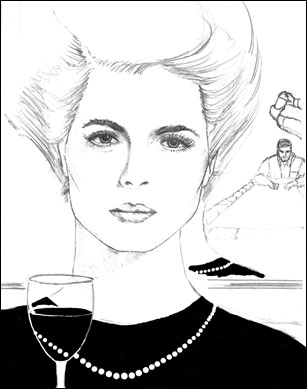
Nearly six years had passed since Lara had told Lance that she had to leave him. It was not that she loved him any less. It was because she knew that something terrible had happened to him, something that would fester and claw at their relationship until nothing was left. She knew that it had happened during his trip to the Himalayas. She often thought of him, but she knew that it would be useless for her to seek him out. She knew that he would have to come to her. He would have to convince her that he was whole again, or at least that he could be made whole with her help. If he never returned, she would still have her memories of their time together, brief though it was.
Seven years earlier she had decided on a lark to read economics at the London School in non-degree status. Her undergraduate degrees from the University of Pennsylvania, where she was a scholarship student, were in literature and drama. Her friends told her that she had really majored in connoisseurship. She had also graduated from Alma Maynard’s Philadelphia School of Dance, and afterwards she had given classes in ballroom dancing, her favorite being the Tango—the dance of love.
She was not that much interested in economics—she at the time having taken a sabbatical from her position as a film critic on the Enquirer—but she thought that anyone with a liberal arts degree could easily handle “the dismal science.” In fact, she had felt fairly dismal just before she enrolled, having heard that her first love, one Sam’l Hargo, the purser on the cruise ship Maricopa, had perished at sea in a violent storm that took the lives of more than half its complement.
One evening Lara decided that she had suffered enough reading about the Laffer curve and supply-side economics. It was the same silly stuff that Lanny Crudlow prattled on about on MSNBC. They were still talking about Adam Smith and his “invisible hand.” Invisible hand, indeed, she thought. It seemed to her that large corporations, in their headlong lust for privatization and profits, had raised the middle finger of that hand to the average worker. Where was the sense of community? Where was the spirit of sacrifice and sharing that FDR had instilled in the American people? All his programs were being dismantled, bit by bit, to feed the hungry maw of corporate America. Lara decided that she needed a drink.
She was sitting at a table at The Red Lion Inn enjoying a glass of Chardonnay when she noticed a man staring at her from the crowded bar. He was an American, she surmised, not only from the way he was dressed, but also from the fact that he had a glass of whiskey on ice in his hand instead of a pint of bitter. Dressed in a black Cashmere pullover and grey slacks, he didn’t have that nubby look that allows anyone with a sharp eye to pick out an Englishman. Lara had two sharp eyes, and she was not shy. She used them to stare back at him.
Then he set his glass down and broke free from the crowd to approach her table. She looked him over. He was of more than average height, thinning black hair going grey at the temples, ruggedly handsome with high cheekbones and a tanned complexion, and with the walk of an athlete. He stood before her, a slight smile on his lips. “Pardon me,” he said disarmingly, “but are you Salma Hayek?”
Lara laughed in spite of herself. Friends had often commented on the facial resemblance. She was reminded of the announced casting for the film Frida and answered cleverly, “Only if you’re Diego Rivera.”
“I think I could be,” the man said. “All I’d have to do is gain thirty pounds and take a couple of art classes.”
Lara had never experienced that sort of pick-up line before. She asked if he would like to sit at her table. “Only if you’ll buy me a drink,” he said.
That did it. She was hooked. “I can’t be Salma Hayek, she said. “I don’t have her eyes.”
“Yes, I can see that now,” he said, looking into her large and shining indigo eyes, “but I can overlook that because everything else seems to be in place.”
Lara felt herself blushing. He sat down at her table and motioned for the waitress. “I drink Glen Levitt,” he said. “How about you?”
Lara pushed her half-finished glass of wine away. “I am particularly fond of single-malt Scotch whiskey,” she said, “and I’d be delighted to drink it with a fellow American.”
That was the start of an intense love affair. Only later, when it ended, was Lara reminded of what falling in love really meant. When you are falling you have the exciting, delicious feeling of speeding through space so fast that it takes your breath away. It is only when you have stopped falling and hit the ground with a jolt that you realize what a risk you took. Lara had taken that risk before, with Sam’l Hargo, but the shock had not been nearly so great as it was with Lancelot Stanley Carter, II.
Sam’l Hargo was a sailor, the older brother of her best friend, Delores. His mother had intended to write ‘Samuel’ on his birth certificate, but she had instead written ‘Saml’. Later, one of his elementary-school teachers added the apostrophe, and he was Sam’l from that day on. Lara fell in love with his image in a photograph Delores had shown her of her handsome brother, Sam’l.
When Lara was fifteen, she attended a “Quince” party at Delores’s house for several classmates. After the guests had left, the two girls retired to their separate bedrooms, Delores’s parents having left for another party with friends. Lara went to the guest bedroom, which had formerly been Sam’l’s room. As Lara lay sleeping, an extraordinary thing happened. Sam’l returned from a sea voyage, duffel bag on his shoulder, to find a young girl sleeping in his bed. Suddenly, Lara opened her striking, sapphire eyes and saw Sam’l standing beside her—standing beside his own photograph.
“Who are you?” he asked huskily.
“I am Lara.”
“Ah, then you must be my Lara,” he said, as he bent over and took her in his arms and kissed her innocent lips. It was Lara’s first kiss. What more is there to tell? One moment Lara was a mere child, and the next she was in her lover’s arms. Lara’s heart and soul had been opened to Sam’l a dozen years before Lance Carter came striding towards her at The Red Lion Inn.
Lara and Sam’l were lovers for four years before Sam’l married the woman his parents had chosen for him. Somewhat surprisingly, his bride’s name was also Lara. But this Lara looked more like Julie Christie than Salma Hayek. About the time Lara Lane Lamont was born, several new mothers in Philadelphia had named their daughters Lara. They had all read Pasternak’s Dr. Zhivago, and the peasant girl who had inspired the Russian revolution bewitched them. Our Lara was bothered early on by this association with a Russian peasant woman, and she was even more annoyed when the blonde-haired and full-figured Julie Christie played Lara’s part in the film. This was why our Lara insisted on using her mother’s maiden name as the middle name in her own. Lara Lane Lamont could easily be associated with connoisseurship, but never with a Russian peasant.
Lara was devastated when Sam’l told her during a restaurant dinner that he was going to marry the other Lara. He told her that they could continue their affair in spite of his marriage. Our Lara was horrified. She told him that if he married the other Lara, then that would be an end of it. Sam’l became possessive. He insisted that his love for her was greater. Lara stormed out of the restaurant and Sam’l followed her. He told her to get into his car. She said she would rather walk home. He grabbed her arm, but she pulled away. Sam’l shouted at her, and she shouted back. He slapped her face and she began to cry. Sam’l said he was sorry, entreating her to forgive him; but she would not. Finally, she got into his car and he drove her home. She sat in silence as far from him as she could, pressed up against the passenger-side door. When they reached her house, Sam’l again attempted to apologize, but Lara would have none of it. She ran up the path to her house, key in hand, and quickly opened the door. That was the last Lara saw of Sam’l Hargo. She did not attend his wedding. When her friend Delores wrote her years later to say that Sam’l had died, Lara shed the tears one keeps in reserve for a first love, but she did not grieve.
Now alone in her apartment in the D.C. suburbs, Lara thought of her two lost loves—the one irretrievably lost, the other not quite lost but perhaps still wandering. She remembered how happy she and Lance had been, how similar their thoughts and value systems were. He shared her love for great literature—for the works of Boccaccio, Dostoyevski, Ibsen, Faulkner, and Dreiser. They both enjoyed reading Oscar Wilde and the short stories of O. Henry. Lara had inherited her love for literature from her father, Louis Lamont, a French Canadian who had adopted the United States as his own with a devotion that only an immigrant can really feel. Her father had also taught her to love the Declaration of Independence and the Constitution. Together they had frequently visited Constitution Hall with its polished banisters and the sweet-smelling wood of the floors on which American heroes had walked and argued.
Lara still missed her father greatly. He had died during her sophomore year at Penn. Louis Lamont’s death seemed to make her mother colder and more distant. She and Lara simply did not share the same interests. Jane Lamont reverted to her maiden name shortly after Louis died, and it somewhat annoyed Lara when her mother, who was quite attractive, would laughingly refer to herself as “just plain Jane Lane.” After graduation Lara got an apartment in south Philadelphia, and she saw her mother infrequently before her mother’s accidental death in London five years later. Plain Jane Lane, returning to her hotel after a shopping spree at Harrod’s, looked carefully to her left before stepping into the street and got hit by a lorry coming from her right. Lara’s first, grieving trip to London was only to recover her mother’s body and return home. How different and magical the city was on her second visit when she could share it with her lover.
Lara made Lance promise that when he finished his M.Phil. thesis he would meet her in Philadelphia. It was to be the coming summer, when Lara’s term was finished and Lance had received his degree. She wanted to show him where she had grown up. She wanted to share with him a ride on the ferryboat up the Delaware River. She wanted to show him the architecture of the Philadelphia Museum of Art, where Duchamp’s “Nude Descending a Staircase” thrilled visitors as it appeared immediately as they entered the central doorway. She wanted to share her past as they planned their future together.
Most surprisingly of all was that Lara and Lance shared the same progressive political views. Despite the wealth that Lance’s father had bequeathed to his son, Lance remained blessed with the common touch. Although he had the accouterment of wealth, it was worn lightly on his person, and he had no affectations. He thought that FDR was a great president, perhaps the greatest, and he thought that B. A. Liar, then the governor of Texas, if nominated by the Repugnican Party and elected by the people, would be the worst president ever. Lance and Lara would sometimes meet halfway between Oxford and London, he driving his Mercedes 500SL down to Henley-on-Thames, or to Marlowe, and she speeding up the M-4 in her Mini Cooper to meet him. They would sit by the fire in a local pub, he with his whiskey and she perhaps ordering a Pim’s Cup. They would talk politics.
“What do you think about this likely Repugnican ticket of Liar and Chancey?” asked Lara, as they sat in The Black Boy pub, just down the road from Henley.
“If the American people are stupid enough to elect that pair, then they probably will get what they deserve,” answered Lance.
“But Lance, then you wouldn’t be getting what you deserve, and neither would I.”
“I’m not so much afraid of them,” replied Lance. “I’m afraid of the cabal that will try to run the country as an empire if they get the chance. Have you read that series of documents they call ‘the Project for the Great American Millennium’?”
Lara had read these documents, a series of letters that advocated regime change—by stealth or by force—in any country that would not acquiesce to the demands of the United States. “What’s interesting to me,” said Lara “is the roles that the wives of the signatories of these letters play in this plan for world domination.”
“Oh,” said Lance, “tell me about that.”
“I’ll tell you about three of these women and what their jobs are. First, there is Lemon Chancey, the wife of the man who would be our vice president. She’s head of the Federal Arts Council, where she advocates censorship of any art form that doesn’t have a political theme of “us above them all.” Then there are the wives of the Krappen brothers, Lon and Ron. Lon Krappen’s wife, Snooky, is our representative to NATO, where she advocates using NATO forces to forcibly supervise elections in South America. Ron’s wife, Karma, heads the Institute for the Study and Uses of War, and she’s invented dozens of scenarios for subduing recalcitrant nations through the use of creative warfare.”
“They sound like the three witches in Macbeth,” said Lance with a smile.
“You don’t know how right you are!” exclaimed Lara. “Every Halloween they gather around their cauldron at the Chanceys’ mansion to fix a meal to share with their husbands and plot the fate of the world.”
“I bet I know what’s in that cauldron,” said Lance. “It’s got to be eye of newt and hind of swine.”
“Don’t forget the sow’s blood and the grease from the murderer’s gibbet,” said Lara, laughing. Then they both laughed together, trying their best to make light of what augured to be a very serious problem.
Those were happy times, thought Lara, as she prepared herself a cup of Murchie’s Black Currant tea, drawn from a packet sent to her by a friend in Victoria, B.C. It was late afternoon and Lara was feeling sad. It was about this time of day nearly six years earlier that Lance and Lara had their penultimate meeting in Philadelphia. Lance had come to visit in her Society Hill home, and they were sharing martinis in her well-appointed drawing room. Lara had inherited the house when her mother died, but she had never liked it that well. It had too much of her mother in it and not enough of her father. She had been thinking of selling the house and moving to D.C., where she could be closer to Lance. She could teach dance in D.C., and she felt sure she could get a job on the Post doing what she was doing in Philadelphia.
Lance arrived late and he appeared distraught. Lara felt that there was something on his mind that he couldn’t bring himself to tell her. She remembered the unsatisfactory dinner they had shared when he first returned from Katmandu and the hurried kiss goodnight. This time Lara was determined to make him tell her what was standing between them. With her characteristic firmness and straightforward manner she set down her martini glass and told him that, whatever it was that was bothering him, she wanted to know what it was. She could handle it.
“Give me your hand,” she said, as she reached forward with her own. Lance put forward his hand, and she took it in both of hers. “Now I want you to tell me everything that happened to you when you were trapped in the ice. There’s something bothering you and I want to know what it is.”
Lance withdrew his hand from her grasp. “I can’t tell you that. Maybe someday I’ll be able to do it, but now I can’t.”
Lara was insistent. “Lance, if you don’t at least make an attempt to confide in me, then I’ll think you don’t love me the way I love you. I just want to help you get over this, whatever it is. I want to know the truth.”
Lance rose suddenly from his chair, nearly spilling his drink. “You can’t handle the truth!” he said, with uncharacteristic violence. Only later did he remember that this was Jack Nicholson’s line in A Few Good Men (the film directed by Robert Reiner), which he would repeat again in other circumstances six years later.
Lara’s eyes widened. What monster had she stirred from its sleep? She put out her hand to him again, but he pushed it away. She was reminded in a flash of the last time she had seen Sam’l Hargo. He had slapped her face. She didn’t want it to happen again. “I think that you had better leave, Lance,” she said. “Maybe when you’re in a better mood we can talk about this again.”
Lance bounded to the door. “I don’t want to talk about it now, and maybe I’ll never want to talk about it!” he shouted. He said nothing more as he rushed out the door, got into his car, and drove away at high speed. A week later she found him, dead drunk, on the pavement outside her home. That was when she had sadly told him that it was over.
Since that last meeting, Lara had not seen Lance, nor had they spoken. On her birthdays she would receive a card from him. It was always signed, “Love, Lance.” That was all it ever said. Finally, she sold the house in Philadelphia and moved to the D.C. suburbs where she got a job as a film reviewer and occasional arts columnist for the Post.
Lance must have seen her work, because just two weeks earlier she had received a letter from him congratulating her on a column she had written. The letter was ambiguous, but it seemed to contain the germ of something about to spring to life again. It said that he was working on a project that he would like to discuss with her when it had been completed. When she read those words, her heart fluttered. She felt a premonition that all these years of waiting—like Penelope waiting for Odysseus—would now perhaps be coming to an end. The wanderer might now be nearing home.
To Be Continued….
Next Week, Episode 3:
Posted in Political | Comments Off
ANOTHER FREE BOOK!
A DI EXCLUSIVE ! ! !
For DI Readers and friends –
Introducing – IN 10 WEEKS OF
SERIAL RELEASES, STARTING … NOW:
Chronicles of the Shade©*
An Impolite, Politically Incorrect—and
Completely Unauthorized
Political Satire on the
Chicanery and Diabolically Evil
Inside Operations of our White House
And Commander In Chief
What follows—beginning with this initial posting–in serialized form–is an allegorical tale that is part science fiction, part love story, part detective mystery, and largely political satire. It has been compressed into ten Episodes, one of which will be published each week on the DW Website…for your exclusive entertainment and enlightening pleasure. An Epilogue will round out the story.
Here is a brief synopsis:
Our protagonist, Lancelot Stanley Carter, II, goes mountain climbing in Katmandu and is trapped in an icy crevasse. In order to survive while hopefully awaiting rescue, “Lance” becomes somehow imbued with “dark energy” type powers, possibly akin to those bestowed by the “dust” in Philip Pulman’s “His Dark Materials” , the trilogy whose wonderful first installment, “The Golden Compass” is presently playing at the box office. Upon being rescued, Lance discovers he can spy upon others unobserved and read their thoughts. His strange power causes him to distance himself from Lara, his true love. Despondent, he gives away his vast fortune and opens The Shade Detective Agency where he utilized his ability to procure information.
Coincidentally, the idealistic Wilberforce B. (Wilby) Goode wants to know what’s going on between President “Barnaby A. Liar” and his Secretary of State, “Condominium Spice”, behind the walls of The “Grey House”and hires The Shade to find out. The Shade takes the job and spies on them and others, recording their shocking conversations—and revelations–on tape.
Will the tapes see the light of day? What is the significance of a mysterious “golden locket” bequeathed to Lance by his madcap Aunt Viva, and what is the connection between the contents of the locket and the bond between Wilby and Lance? Will our heroes succeed or will President Liar begin yet another war? Will Lance be reconciled with Lara? What do the words in the locket mean? All this will be revealed in the serially-unfolding mystery, “Chronicles of the Shade”.
Although this is a work of fiction, it should be obvious that political players in the real world (principally the Neo-cons who took command of the White House and Pentagon following 9/11/01) inspired the caricatures of the political figures described. Accordingly, it might be useful to think of the events and characters depicted in our tale as inhabiting a possible world that is a close relative of our actual world…sort of like one of those millions of parallel universes in Pullman’s Dark Materials. Such a world, according to modern physicists, is consonant with the laws of quantum mechanics, which twenty-first century science accommodates by postulating many parallel universes along with our own. Thus, the characters and events described might be said actually to exist in some parallel universe, dimension or time. How closely they mirror what exists presently in our own world is for the reader to determine.
The authors of these Chronicles, one of whom is a regular DI contributor (have fun guessing who!) have chosen to withhold their true identities by writing as “Margot Cranston” and “Sam Miller”, believing that it is the tale that matters and not who tells it. As Shakespeare had Hamlet put it– “The play’s the thing.” Now, onward with the unfolding of our tale.
GRAPHIC ILLUSTRATIONS BY: CHARLES CROTTS
Special thanks—and Kudos– go out to our illustrating artist, Charlie Crotts. Charlie (a Viet Nam Veteran) is a renown freelance North Carolina artist who serves, in conjunction with wife, Jan, as President and C.E.O. of Knightsbridge Printing Company of High Point (Knightsbridge, Inc., 2008 Nuggett Road, High Point, 27263; Ph (336) 889 7156)—for the information and benefit of any of you out there in need of anything along the printing gamut from classically-expert fancy silk screen to 4-color solid or processed offset. Knightsbridge’s foremost commissioning client today is our U.S. Government.
All Rights Reserved:
*Printed by DeclaringIndependents.com with express and exclusive permission of the authors, who, in conjunction with DI reserve all claims and rights under existing state and US Federal Copyright law to prohibit the unauthorized copying, duplicating and/or dissemination in any fashion of any part of the present or future publishings by DI on this website of any of the 10 chapters or episodes which here appear and/or follow without the written permission and formal authorization of DI and the authors of “The Chronicles of the Shade”.
Chronicles of The Shade
By Margot Cranston and Sam Miller
 |
Episode 1 – Beneath the Ice |
|---|
Time – May 2001
It had all started after his Aunt Viva’s funeral in Paris. Her good friend, former lover, and fellow hot-air balloonist, François Francon, had approached him at the graveside and asked whether he planned to go on the mountain-climbing expedition that Viva had arranged for them. François was still going. “It was what she would have wanted us to do,” he said. “I want to plant the French flag on the summit and do it in Viva’s name. Viva la Viva!”
Grief-stricken, Lance was determined to do what Viva had planned for him to do–one last exciting adventure before returning to the United States and to Lara. He had telephoned Lara at her London flat. The climbing trip was to take only two weeks. He would then meet her in Philadelphia as they had planned. Viva’s death had happened all too suddenly. He needed to find a way to assuage his grief and to say goodbye.
Things did not work out as planned. On the third day of the climb, Lance had been too weary to retrieve the pitons he had placed on the eastern face of the mountain. He would have to go back for them before dark. With the sun rapidly setting, the east face was already in semi-darkness when Lance returned. He would have to hurry. With uncharacteristic carelessness, Lance did not check to see that his uppermost piton was firmly embedded in the ice before he attached his rope to it. As he slid down his rope, the piton came loose, and Lance found himself swirling down the slope, his rope trailing uselessly behind him. Digging in his heels, he slid for more than 100 feet before his body plunged into the crevasse. Then there was another breathtaking plunge of 200 feet before his fall was stopped because the split in the ice had become too narrow to allow his body to descend any farther. So there he found himself, in pitch darkness, wedged in the ice 200 feet below the surface.
His first thought was that he was a dead man. He would not be missed until morning, and even if his party found the pitons, where would they know to look for him? Even if they found him, how could they retrieve him from the crevasse before he froze to death? Then he took stock of himself. He was not a quitter. Viva would not have wanted him just to curl up and die. Lara had not fallen in love with a quitter. No, if death came, it would have to take him, because he would not go quietly.
He then turned his thoughts to Lara. He remembered their meetings on weekends in her Kensington flat. He remembered the rain that invariably kept them inside, the tea and toast they shared before stretching out on her narrow bed, lying on their sides, face to face. He captured in his mind’s eye the way her lips turned downward slightly just as she was about to smile. He remembered looking into her eyes, her deep and dark sapphire eyes, deeper than the Mindanao depths. He could have gazed into her eyes forever, swimming in them, drowning in them; and he remembered the feel of her mouth on his, and the way she pressed her supple body to his, and the way they seemed to melt into one form and one being. Oh, Lara, he thought, within the confines of the dark ice, would that thoughts of you could set me free.
Hours passed beneath the ice. It seemed as if the air had turned lighter. The sun must be rising, he thought. Soon it would pass over the crevasse. As the sun rose higher, the ice took on color. Above him the ice had turned to an electric blue, caused by the alluvial particles suspended in it. Even in his predicament, Lance could appreciate its beauty. Then the sun passed beyond the crevasse, and it began to get dark again. There was no sound above him, no sign of any rescue attempt. Lance remembered the time long ago when Viva had taken him up in her hot-air balloon and turned off the burners. The silence was like that. Thoughts of Viva prompted Lance to reach for her golden locket in the inside pocket of his parka. He slipped off his thermal glove and had just enough room to grasp the locket in his fist. He put his glove back on, clutching the locket, and concentrated on words inscribed on the little paper inside.
“Preserve the Union,” Lance said. He said it over and over again, as if the locket and its contents were some powerful talisman. Viva had wanted him to have the locket. She had wanted him to use it to some purpose, even though neither of them knew what the words signified. Lance thought that if he could concentrate on fulfilling that purpose he could overcome this obstacle that had been set in his path. He could hold on until rescue came. He would not go quietly. He would be lifted from beneath the dark ice out into the bright world again.
More time passed. Lance’s body was becoming numb. He could no longer feel the locket clutched in his fist. The sun was passing over the crevasse again. The blue ice above him shimmered in the light. Unbidden thoughts came to him. First there was the thought in him saying, “Your life has a purpose.” Then the came the opposing thought, “Your life is a joke in a meaningless cosmos.” He did not think these thoughts. They came to him, in succession, warring together in his mind. Finally, just before he lost consciousness, the sun directly over the crevasse blinded him, and one final thought came. It was, “Renounce the world!” Then a blissful peace washed over him, and he slept. While he slept his heart rate slowed almost to a stop. Twelve hours later, when the Sherpa guide slipped the rope around his body to haul him from the crevasse, he was still sleeping peacefully in a state of suspended animation.
****
July 2007
Now, six years later, The Shade stood behind the drapes in a corner of the Elliptical Office of the Grey House in Reagan, D.C. The library next to the Office had been empty, so it was no trouble for him to retrieve the tape recorder he had placed there two weeks earlier. It fatigued him to slow his heartbeat for longer than five minutes, yet that was the only way he could remain unnoticed among those who lived in the real world. His condition was the result of the mountain-climbing accident six years earlier on the east face of Guarisanker in the Himalayas. He had been trapped for forty-eight hours in an icy crevasse, his body temperature dropping until his heart was beating only twice a minute. When he was finally rescued, he discovered that he had the power to lower his heartbeat at will, almost to the point of stopping it, and thus he was able to create his own time-frame and to slide through the time frames of others without being noticed. After five minutes his natural bodily rhythms asserted themselves, and he could no longer count on being unobserved. Now his heartbeat was normal, and he wanted to rest while concealed by the drapes before retrieving the second tape recorder that he had secreted in the Elliptical Office.
Suddenly the doors to the Elliptical Office opened, and President B. A. Liar shuffled into the room. He first glanced at the empty dish on his desk, and then he began frantically to open and shut the drawers to the desk, all the while perspiring profusely, his mouth working in minute spasms. Finally, he punched a button on his intercom and shouted, “Cal, you come in here! You come in here right now, and you fill up this durn dish!”
Only half a minute passed before a portly, white-faced man with rimless eyeglasses entered the room. In his hand he held a cellophane bag filled with Hershey’s candy kisses. It was Cal Stove, the President’s political strategist and top assistant. Slowly, Stove filled the candy dish on the desk, being careful not to let any candy spill over. It was too slow for the President, who snatched up a handful of candies, ripped off their surrounding tinfoil, and popped them into his mouth, two at a time.
The Shade knew that many former cocaine addicts had a craving for sweets, and it had been rumored that President Liar had a sweet tooth. He hadn’t realized, however, that the President was a chocoholic. For years his wife Ada had rationed out his chocolates, instructing Cal Stove to empty the candy dish in the Elliptical Office each evening before leaving. The President had tried to hide chocolate bars in his desk, but Stove had always confiscated those, as well.
Now the President was feeling relaxed and jovial. He smiled at Stove and said, “Hey, Cal, how about a kiss?” and he guffawed as Stove involuntarily took a backward step. “I meant a candy kiss, you idjut!” he said, proffering the dish to Stove.
Stove raised his hand, saying, “No thank you, Mr. President, I’m on this diet.”
“Yeah, well it don’t show,” smirked the President. “So whatcha got for me today, worm-toad? And don’t call me ‘Mr. President’. You know I like you to call me ‘Chief’.
“Right, Chief,” said Stove, “I’ve got good news. Your poll numbers bumped up two points over the weekend. Pretty soon you’ll be back to 30 percent.”
“Ha!” said the President, clapping his hands together, “I knew it. My trip to Kansas to talk to my base musta’ really done it. I had those folks eatin’ out of my hand.”
“I guess that’s what you’d call your sub-base, Chief,” said Stove. “You know your real base is in the board rooms of corporate America.”
“Yeah, whatever,” said the President. “You shoulda’ heard the cheers when I pointed up to the sky and said, “Somebody sure loves stem-cells! Then this band starts playin’, and Cobby Teefe starts singin’ ‘Jay-zus Loves the Little Stem Cells’ with all these snowball babies behind him. That really brought the house down.”
“Um,” said Stove, “I think that’s snowflake babies, Chief.”
“Whatever,” said the President, waving his hand in annoyance. “You got anything else for me? Because I got to make this decision about bombing Iroon, and I want to know what you think.”
“In my experience, Chief,” said Stove, “it’s not a good thing to bomb when you’re under 30 percent. Maybe you should give it a week. Go to Mississippi this time and talk about teaching intelligent design in the science courses. That should bump
you up enough to get the bombs dropping.”
“Good idea, wart-toad,” said the President brightly. “But I better not take my veep with me, ‘cause they take one look at him and they won’t believe a word I say!”
Both Stove and Liar had a good laugh at the Vice President’s expense, and then the President began to regale Stove with all the Kansas jokes he had heard on his recent trip.
The Shade tried not to hear the snickers, giggles, and other inanities spilling out of the mouths of the President and his aide. He tried to blot them out by reflecting on how he, Lancelot Stanley Carter, II, had been easily able to enter the office of the most powerful man on earth, how his experience in the icy crevasse had turned him into The Shade, someone who could lower his heartbeat will and thereby remain unobserved by others while he observed them. Lance Carter was well aware that this singular power required judicious use, for the fruits it bore could be used for either good or evil.
The Shade snapped out of his reverie. The President and his aide had left the room. The candy dish was almost empty. The Shade stepped out from behind the drapes and put his hand under the picture frame behind the President’s desk. The tape recorder was still there. He placed it with the one he had taken from the library in the flat, metallic box that his friend had made for him. It was a titanium alloy, designed to block any radiation from coming through to erase the tapes. He was confident that the tapes could now be taken safely from the Grey House. Before slowing his heartbeat so that he could slip away undetected, The Shade took a candy kiss from the dish. The President would never miss it.
…TO BE CONTINUED…..
Next Week’s Exclusive DI Installment to be entitled…
Episode 2 – Lara’s Song
Posted in Political | Comments Off
A DI EXCLUSIVE ! ! !
For DI Readers and friends –
Chronicles of the Shade©*
PART 1
By Margot Cranston and Sam Miller
An Impolite, Politically Incorrect—and
Completely Unauthorized
Political Satire on the
Chicanery and Diabolically Evil
Inside Operations of our White House
And Commander In Chief

|
Episode 1
|
|
|---|---|
|
Episode 2
|
|
|
Episode 3
|
|
|
Episode 4
|
|
|
Episode 5
|
|
|
Episode 6
|
|
|
Episode 7
|
|
|
Episode 8
|
|
|
Episode 9
|
|
|
Episode 10
|
|
Posted in Political | Comments Off ← Older posts Newer posts →